How to Choose an EV Charging Cable: The Spec-by-Spec Buyer's Guide
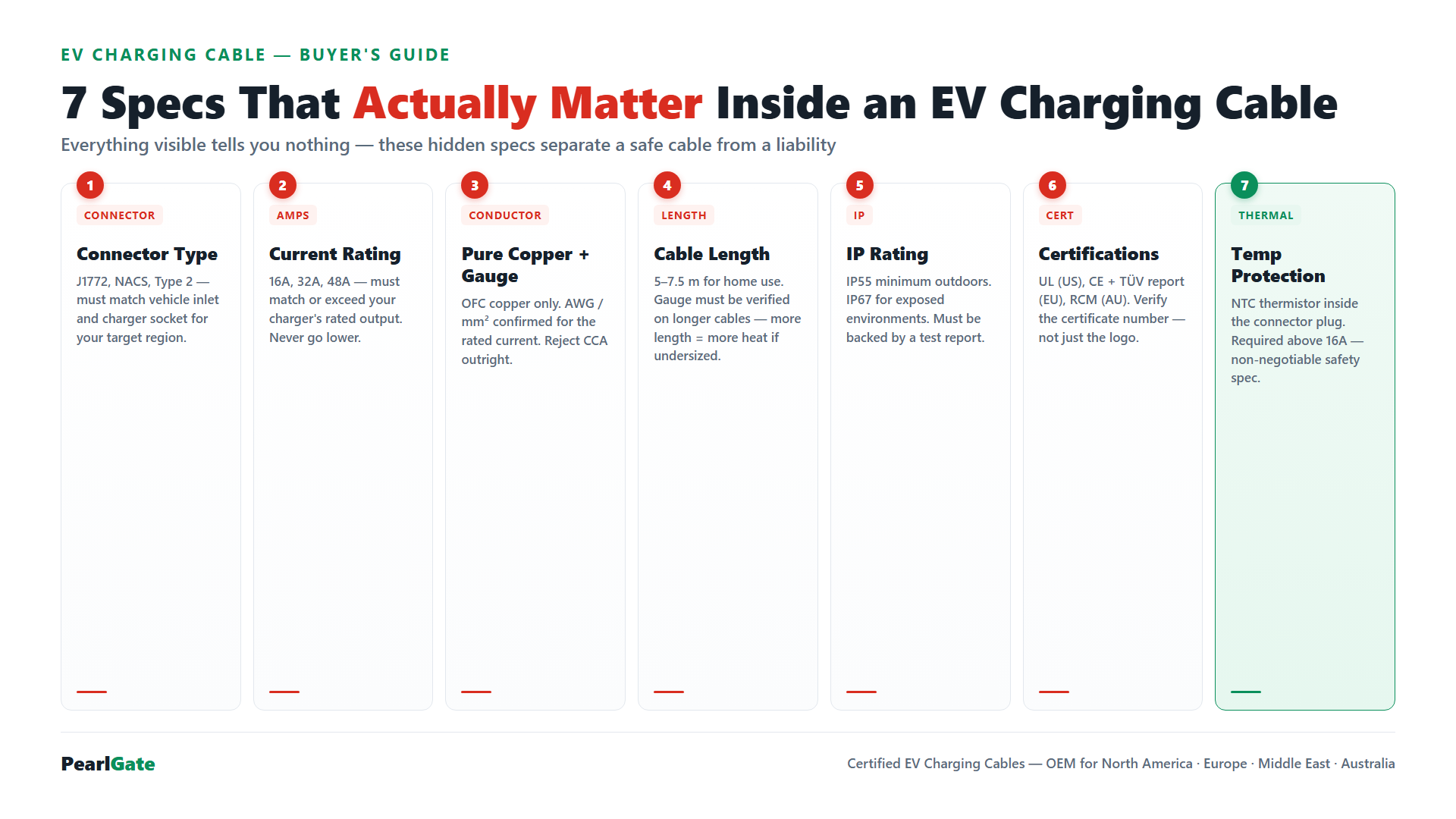
Most EV charging cable "buying guides" online are actually brand comparison lists. They tell you which brand has the best Amazon reviews, which one comes in red, and which has the nicest carrying case. What they almost never tell you is the one thing that separates a cable that runs safely for five years from one that melts into your charge port in six months: the specs inside the jacket.
After 11 years managing electronics manufacturing and quality at BYD — building products for Dell, Lenovo, Siemens, and others — I've learned that a cable's outer appearance tells you almost nothing about whether it's safe. The specs that matter are all hidden: the conductor material, the wire gauge, the connector contact plating, the temperature protection, the IP rating, the certification depth. Every one of them can be cut to save money without any visible trace.
This guide walks through each spec, explains what it means in plain language, tells you what to demand, and shows you how to verify it. Whether you're an EV owner buying one cable or a distributor sourcing a container load, the framework is the same.
Step 1: Match the Connector to Your Car and Region
This is the only step where the wrong choice is immediately obvious — a mismatched connector simply won't plug in. But it's still worth understanding what you're buying, because connector type determines compatibility with future charging infrastructure, not just your current vehicle.
The four connectors in active use worldwide
J1772 (SAE J1772, "Type 1") The standard AC charging connector in North America and Japan. Single-phase, rated to 80A / 19.2 kW. Found on virtually every non-Tesla North American EV from 2010–2024. EVSE stations use J1772 on the tethered cable side; the vehicle inlet is the mating socket on your car.
NACS (SAE J3400, formerly "Tesla connector") Now the North American standard, with virtually all US automakers committing to it from 2025 onward. NACS handles both AC (Level 2) and DC fast charging through the same small connector. For portable Level 2 cables, a NACS-to-J1772 or J1772-to-NACS adapter matters increasingly as the fleet transitions.
Type 2 (IEC 62196-2, "Mennekes") The standard AC connector in Europe, Australia, and much of Asia. Handles single-phase (up to 32A / 7.4 kW) and three-phase (up to 32A / 22 kW). Most home wallboxes in Europe use Type 2. If you're selling into the EU market, Type 2 is non-negotiable.
GB/T (GB/T 20234) China's domestic standard. Not cross-compatible with J1772 or Type 2 without an adapter. Relevant for mainland China market products; largely not applicable for North American, European, Middle Eastern, or Australian distribution.
The cable end you're buying
A charging cable (also called a Mode 3 cable or EV cable) has two connector ends: the vehicle end (plugs into your car) and the EVSE/station end (plugs into the wallbox or public charger). These may be the same connector type (Type 2 to Type 2 in Europe, J1772 to J1772 in North America) or mixed (NACS vehicle end to J1772 station end, or Type 1 to Type 2 for cross-region adapters). Know both ends before ordering.
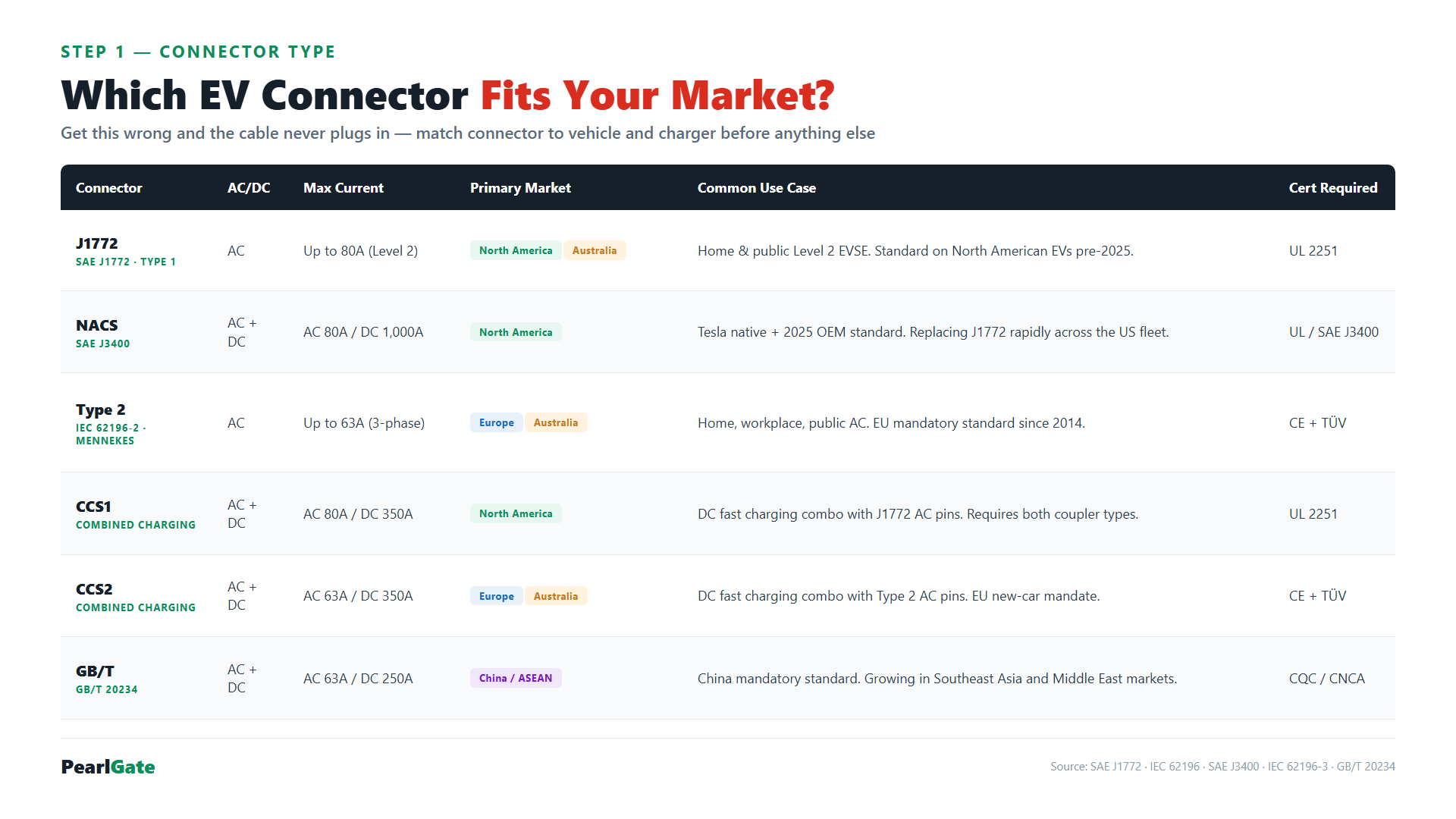
EV connector types comparison — J1772, NACS, Type 2, CCS1, CCS2, GB/T
Step 2: Determine the Current Rating You Actually Need
The connector type tells you compatibility. The current rating tells you charging speed — and it directly determines which internal conductor specs are safe.
How current rating translates to charging power
| Current | Voltage | Power | Approximate charge time (60 kWh EV) |
|---|---|---|---|
| 16A | 240V (US) | 3.8 kW | ~16 hours |
| 32A | 240V (US) | 7.7 kW | ~8 hours |
| 40A | 240V (US) | 9.6 kW | ~6 hours |
| 32A | 400V 3-phase (EU) | 22 kW | ~3 hours |
Most home wallboxes in North America run at 32A or 48A. Most European home wallboxes run at 16–32A single-phase. Don't buy a cable rated higher than your charger; it adds cost and weight with no benefit. Don't buy one rated lower; it will overheat.
Why this number matters more than the brand name
EV charging is a continuous load — unlike a phone charger that cycles on and off, a 32A EV cable carries near-full current for 6–10 hours overnight. The NEC (US National Electrical Code, Section 625.42) and equivalent European standards (IEC 61851) treat EV charging as a continuous load and require equipment rated at 125% of the charging current. A cable that handles a brief test fine can still fail during real overnight use. This is why the current rating drives every other spec decision below.
Step 3: Verify the Conductor — The Most Important Hidden Spec
This is where cheap cables hide their cost-cutting, and where the most dangerous failures originate. Full background in our Common EV Charging Cable Problems article; here's what you need to demand when buying.
Pure copper only — no exceptions
The single most common quality shortcut is copper-clad aluminum (CCA): an aluminum wire with a thin copper coating that looks identical to solid copper from the outside, costs about 40% less, and has 60% higher electrical resistance. CCA cables run hot, the connections fail from thermal cycling, and aluminum's oxide layer creates progressive resistance at terminals over time.
How to check: Ask for the material spec sheet. The cable label should say "pure copper" or "oxygen-free copper" (OFC), not just "copper" (which can mean CCA). If you're sourcing in volume, a cross-section cut and basic resistivity test will confirm it.
Conductor gauge must match the current rating
Lower AWG number = thicker wire = lower resistance = less heat. A cable marked "32A" but built with undersized conductors will overheat in real use. The jacket looks identical.
Minimum conductor specs for a quality flexible charging cable:
| Continuous Current | Minimum Conductor (flexible cable) | What cheap cables use |
|---|---|---|
| 16A | 14 AWG / 2.5 mm² | 16–18 AWG |
| 32A | 10 AWG / 4–6 mm² | 12–14 AWG |
| 40A | 8 AWG / 10 mm² | 10 AWG |
| 48A | 6–8 AWG / 10–16 mm² | 10 AWG |
How to verify: Ask for the conductor cross-section spec in mm² (the IEC unit) or AWG. A reputable supplier will provide a test report with this figure. If the only answer you get is "it meets the current rating," push harder — that's not a spec.
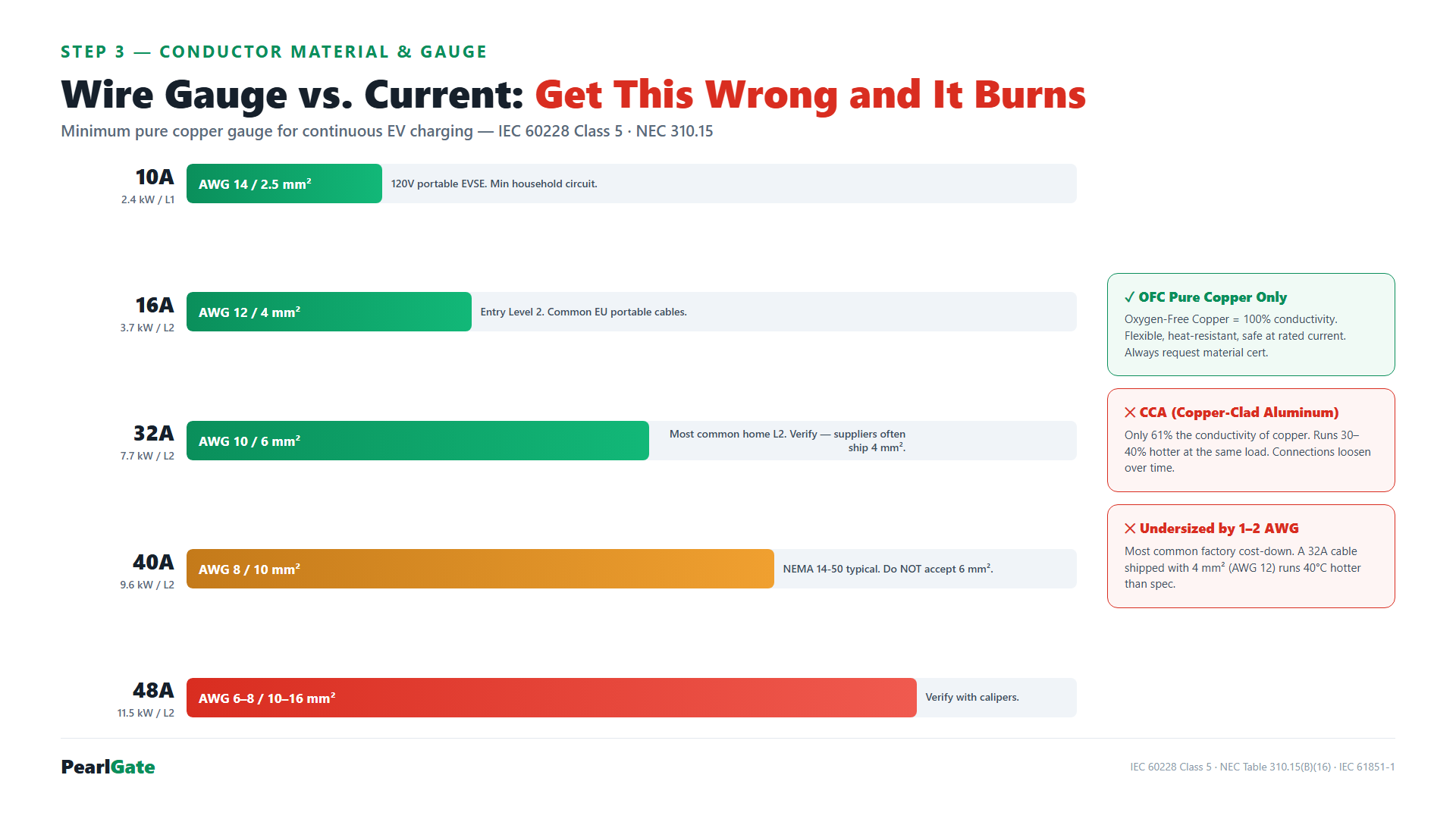
EV charging cable conductor gauge vs current rating chart
Step 4: Choose the Right Cable Length
Longer sounds better. It usually isn't.
The real-world constraint: Your charge port location and parking situation determine the length you need. Most home charging setups work fine with a 5 m (16 ft) cable. A 7.5 m (25 ft) cable covers more scenarios. Beyond that, you're adding resistance, weight, and trip hazards without a meaningful benefit for most users.
The resistance problem: A longer cable has more total resistance, which means it runs slightly hotter at the same current (remember: P = I²R). A quality manufacturer compensates with a slightly larger conductor cross-section on long cables. A cheap manufacturer doesn't — they just make the same thin cable longer.
For distributors: If your customers ask for "the longest cable possible," it's usually a range anxiety response, not a measured need. A 7.5 m cable covers nearly every home driveway and parking scenario. For commercial or hospitality use, a 10 m tethered cable on a wallbox is the more appropriate solution than a longer portable cord.
What to check: On cables over 7 m, ask specifically whether the conductor gauge is the same as the shorter version of the same rated current. It should be equal or larger.
Step 5: Confirm the IP Rating for Your Use Environment
IP (Ingress Protection) rating, defined by IEC 60529, tells you how well the cable's connectors and housing resist dust and water. The format is IP followed by two digits: the first is dust protection (0–6), the second is water protection (0–9).
| IP Rating | What it means | Suitable for |
|---|---|---|
| IP44 | Splash-proof from all directions | Protected outdoor use, light rain |
| IP55 | Jet-proof (low pressure) | Standard outdoor use |
| IP67 | Full immersion to 1m for 30 min | Exposed outdoor, heavy rain, puddles |
| IP68 | Continuous immersion (depth specified) | Underground installations |
For home use in North America or Europe: IP55 is the practical minimum for a cable that will live near a garage entrance or carport. IP67 is the right spec if the cable regularly sits on wet pavement or in environments with standing water — and it's increasingly the expected minimum for B2B buyers in commercial and fleet contexts (more on why in our Type B RCD and IP67 reliability guide).
The certification trap: IP ratings are only meaningful when tested by an accredited lab and backed by a certificate number you can look up. A product listing that claims IP67 with no test report behind it may be self-declared — which is legally meaningless and technically unreliable. The same applies to automotive-grade claims.
Step 6: Verify the Certifications — And Actually Verify Them
This is the step most buyers skip, and the one that separates a compliant product from a liability.
The certificates that matter by market
| Market | Required | Meaning |
|---|---|---|
| United States | UL Listed (UL 2594) | Safety tested by Underwriters Laboratories |
| European Union | CE mark + TÜV/VDE/KEMA test report | Self-declaration backed by accredited lab testing |
| Australia / NZ | RCM mark | Regulatory compliance mark (SAA/EESS registration) |
| United Kingdom | UKCA | Post-Brexit equivalent of CE |
The self-declaration problem: In the EU, a manufacturer can legally self-declare CE compliance without third-party testing for some product categories. In practice, a cable with only a self-declared CE mark and no underlying test report from an accredited body (TÜV, KEMA, Intertek, SGS, Bureau Veritas) should be treated with the same skepticism as no mark at all.
How to verify a certificate is real
- Ask for the certificate number. Every legitimate UL or TÜV certificate has a unique, searchable number.
- Look it up. UL: iq.ul.com. TÜV SÜD: certificate lookup on their website. TÜV Rheinland: similarly. KEMA: searchable database.
- Check the product scope. Confirm the certificate covers the exact product (charging cable, the correct current rating, the correct connector type) — not a similar product from the same factory that happens to look the same.
- Request the full test report. A certificate number proves the product was tested. The test report shows what was tested and the results. For critical infrastructure like charging cables, the report matters.
For distributors: A supplier who can provide certificate numbers and welcomes verification has passed the first trust gate. A supplier who says "we have all certifications" but can't provide a number to look up has failed it.
Step 7: Tethered vs. Untethered — The Architecture Decision
This applies mostly to distributors and installers selecting cable configurations; most EV owners buy a portable cord rather than a wallbox.
Tethered cable: Permanently attached to the EVSE (wallbox). Convenient — users just grab and plug. Downside: if the cable is damaged, the whole unit may need servicing. Common in residential and commercial wallbox installations.
Untethered (socketed) wallbox + separate cable: The wallbox has a Type 2 or NACS socket; the user brings their own cable. More flexible, especially in Europe where different cars may use different cable configurations. Common in public charging and shared residential installations.
Portable EVSE / granny charger: The cable is the charging unit — a portable box with a control module built in, plugging into a standard outlet on one end and the vehicle on the other. Useful as a backup or travel charger, not as a primary daily solution for 32A+ charging.
For most residential installations in North America: tethered 32A or 48A wallbox with a J1772 or NACS cable. For most European residential: tethered or socketed Type 2 wallbox. For distribution: understand which your end customers are buying for, because OEM cable specs and termination differ significantly.
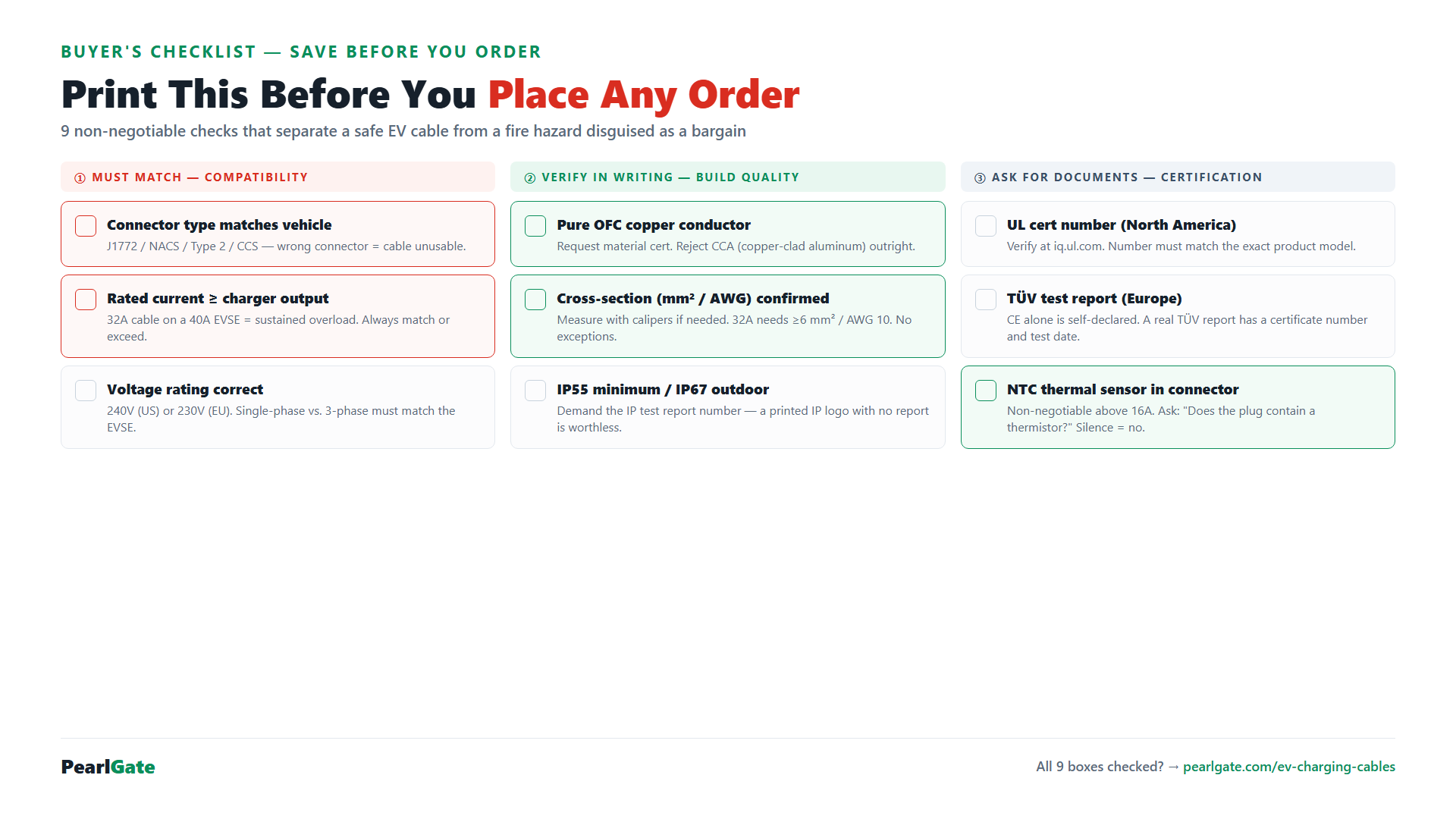
EV charging cable buyer's checklist — 9 specs to verify before ordering
The Buyer's Checklist at a Glance
Use this before you order — whether it's one cable or a pallet:
| Spec | What to ask for | Red flag |
|---|---|---|
| Connector type | Matches vehicle inlet and charger socket | Adapter required you didn't plan for |
| Current rating | Matches or exceeds your charger's rated output | "It's 32A-compatible" without a data sheet |
| Conductor material | Pure copper (OFC), spec sheet provided | "Copper" only, no cross-section data |
| Conductor gauge | AWG / mm² confirmed for the rated current | Jacket diameter given instead of conductor spec |
| Cable length | 5–7.5 m for home use; gauge verified for length | Longest available without conductor size confirmation |
| IP rating | IP55 minimum; IP67 for exposed outdoor | IP claimed with no test report |
| Certifications | UL (US), CE + TÜV report (EU), RCM (AU) | "All certificates available" with no number |
| Temperature protection | NTC sensor in connector confirmed | Not mentioned; no mention in spec sheet |
Frequently Asked Questions
What is the difference between a Mode 2 and Mode 3 EV charging cable?
Mode 2 refers to a portable cable with a built-in control box (ICCPD) that plugs into a standard household outlet — also called a granny charger. Mode 3 is a cable for dedicated EV charging stations (wallboxes and public chargers) without a built-in control box; the EVSE handles the communication. For any serious charging setup, Mode 3 on a dedicated circuit is safer and faster.
Does cable length affect charging speed?
No meaningful effect under 10 m with a correctly sized conductor. A well-made long cable uses a larger conductor cross-section to compensate for added resistance. A cheap cable uses the same thin conductor and runs hotter at the same current — so length amplifies quality problems without affecting speed in a good cable.
Can I use a 32A cable on a 16A charger?
Yes. A higher-rated cable on a lower-output charger is fine — it's simply overspecified. The cable will run cooler than at its rated capacity. The reverse (16A cable on a 32A charger) will overheat.
How do I know if a CE mark is genuine?
A genuine CE mark for a charging cable in the EU should be backed by a Declaration of Conformity and, for a safety-critical product like a charging cable, by a test report from an accredited laboratory (TÜV, KEMA, Intertek, SGS, Bureau Veritas). Ask for the DoC and the test report number. If the supplier can only show a CE logo printed on the product, treat it as unverified.
What does IP67 mean for a charging cable connector?
IP67 means the connector housing is rated for complete dust-tight protection (first digit: 6) and immersion in water up to 1 meter for 30 minutes (second digit: 7). For EV charging cables used outdoors in exposed conditions — rain, puddles, hose runoff — IP67 is the right minimum spec for the connector housing. The cable jacket itself is typically rated separately.
Is a temperature sensor inside the connector really necessary?
Yes, for any cable above 16A. A thermistor or NTC (Negative Temperature Coefficient) sensor embedded in the connector monitors contact temperature and triggers a cutoff if it rises abnormally. Without it, a failing connection — a worn spring contact, a loose crimp, oxidized plating — can continue to heat up until it melts or ignites. Most reputable cable manufacturers include thermal protection as standard; its absence is a quality signal.
How long should an EV charging cable last?
A quality cable with pure copper conductors, correctly sized for its rated current, properly rated IP housing, and real certifications should last 5–10 years under normal residential use. Premature failure — under 3 years — typically indicates undersized conductors, CCA wire, or connector quality issues. The bend radius at the vehicle plug is also a wear point; look for a cable with a molded strain relief at both ends.
The Bottom Line
Buying an EV charging cable comes down to five things that are all invisible from the outside: the conductor material, the conductor gauge, the IP rating backed by a test report, the certifications you can actually verify, and the thermal protection inside the connector. Everything else — the brand name, the carrying case, the LED indicator — is secondary.
If a supplier can hand you a data sheet with conductor cross-section in mm², a UL or TÜV certificate number, and an IP test report, you're dealing with a product worth buying. If the best answer you get is "it's 32A-rated" and a photo of a connector, you're one overnight charging session away from the failure modes described in our Common EV Charging Cable Problems guide.
Related Articles
-
Common EV Charging Cable Problems (And How to Spot One That Won't Melt)
-
Reliability First: Type B RCD, IP67, and Why B2B Buyers Stopped Buying Cheap
Sourcing Cables That Pass This Checklist?
At PearlGate, we help overseas distributors and installers source EV charging cables that pass every point above. Pure-copper conductors, verified conductor cross-sections, IP67-rated connector housings, in-connector thermal protection, and verifiable UL, CE (TÜV), and RCM certificates — with full test reports available before you place a purchase order.
Every product recommendation is backed by 11+ years of electronics manufacturing and quality engineering experience, including on-site factory verification at our primary manufacturer in Dongguan.
For distributors ordering 10–1,000+ units: we handle OEM/ODM cables in J1772, NACS, and Type 2 configurations for North American, European, Middle Eastern, and Australian markets.
Request a Sample | View Our EV Charging Cables
Last updated: June 22, 2026
Sourcing EV Charging Equipment from China?
I'm based in the Pearl River Delta with 12 years of supply chain experience. I help buyers find verified EV charging manufacturers, verify certifications, and coordinate factory visits.
Subscribe for more guides like this
Get sourcing tips and new factory alerts. Free, no spam.
No spam. Unsubscribe anytime.