CCS1 vs CCS2: Complete Guide for EV Charger Sourcing (2026)
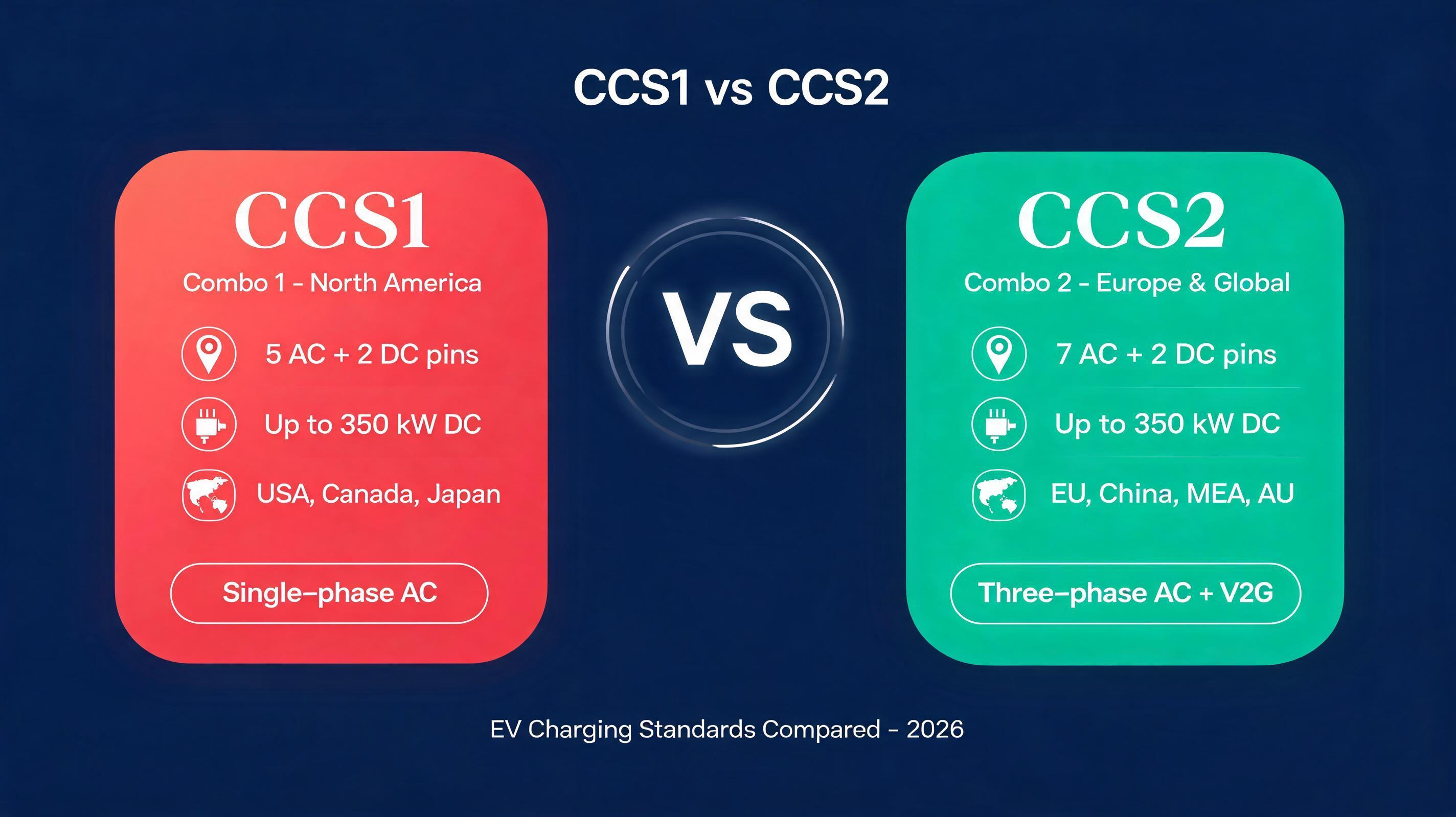
If you're sourcing EV chargers from China for overseas resale, picking the wrong CCS standard is one of the most expensive mistakes you can make. A container of CCS1 chargers landed in Germany is unsellable. A pallet of CCS2 units arriving in Texas will sit in your warehouse.
The technical difference between CCS1 and CCS2 is simple. The sourcing implications are not. This guide covers what every EV charger buyer needs to know — connector design, regional markets, communication protocols, V2G capability — and ends with the part most factory-comparison articles skip: what to verify on the factory floor before you place a PO.
CCS1 (left, North America) and CCS2 (right, Europe) — same DC pins, different AC base, completely different markets.
What Is CCS1?
CCS1 (Combined Charging System Combo 1) is the DC fast charging standard used in North America and Japan. The "Combo" name is literal: the connector combines an AC charging plug with two DC fast-charging pins in a single housing.
CCS1's AC base is the SAE J1772 (Type 1) connector — a 5-pin single-phase AC plug that's been standard in North America since 2010. CCS1 takes that J1772 base and adds two large DC pins below it, giving you one cable that handles both Level 2 home charging (up to ~19.2 kW AC) and DC fast charging (up to 350 kW).
CCS1 at a glance:
- AC base: J1772 / SAE Type 1
- Total pins: 5 AC + 2 DC = 7
- Phase support: Single-phase only (matching North American grid)
- Max AC current: 80 A
- Max DC power: up to 350 kW (typical deployments 50–250 kW)
- Communication pins: 6
- Backward compatible with all J1772 Level 1/Level 2 stations
Where you'll see CCS1: Chevrolet Bolt, Ford Mustang Mach-E (NA), Ford F-150 Lightning, Nissan Leaf (newer trims), and most non-Tesla EVs sold in the United States and Canada through 2024.
What Is CCS2?
CCS2 (Combined Charging System Combo 2) is the DC fast charging standard used in Europe, the Middle East, Australia, and most of Asia (excluding Japan). It became the EU's mandatory standard for public DC fast chargers in 2014.
CCS2's AC base is the IEC 62196-2 Type 2 (Mennekes) connector — a 7-pin AC plug designed for Europe's three-phase grid. Like CCS1, it adds two DC pins below the AC base. Unlike CCS1, CCS2 supports three-phase AC charging up to 43.5 kW, which is why public AC chargers in Europe routinely deliver 11 kW or 22 kW from a single connector.
CCS2 at a glance:
- AC base: Type 2 / Mennekes (IEC 62196-2)
- Total pins: 7 AC + 2 DC = 9
- Phase support: Single-phase and three-phase
- Max AC current: 32 A per phase (three-phase = 22 kW)
- Max DC power: up to 350 kW (typical deployments 50–350 kW)
- Communication pins: 9
- Liquid-cooled cable support for sustained 250 kW+ delivery
- Backward compatible with all Type 2 AC stations
Where you'll see CCS2: BMW i4 / iX, Audi e-tron, Porsche Taycan, Tesla Model 3/Y (Europe), Renault Zoe, BYD Seal/Atto 3 (export markets), NIO, Xpeng. CCS2 is the de facto global standard outside North America.
Key Differences at a Glance
| Feature | CCS1 | CCS2 |
|---|---|---|
| Primary markets | North America, Japan | Europe, China, Middle East, Australia |
| AC base | J1772 (Type 1) | Mennekes (Type 2) |
| AC pins | 5 | 7 |
| DC pins | 2 | 2 |
| Communication pins | 6 | 9 |
| Phase support | Single-phase | Single + three-phase |
| Max AC power | 19.2 kW | 43.5 kW (22 kW typical) |
| Max DC power | 350 kW | 350 kW (450 kW with MCS roadmap) |
| Liquid-cooled cable | Optional, less common | Standard above 200 kW |
| V2G (bidirectional) | Limited | Native ISO 15118 support |
| Plug & Charge | Supported | Fully supported |
| Connector size | Larger | Smaller, more ergonomic |
| Primary safety standard | UL 2202 | IEC 62196-3 + EN 61851-1 |
The single most important row in this table for sourcing is the first one. The standard isn't a feature you choose — it's dictated by the country your chargers are sold in.

Global map of CCS1 vs CCS2 dominance with NACS overlay
Regional Markets: Where Each Standard Dominates
North America (CCS1, transitioning to NACS)
Until 2023, CCS1 was the unchallenged DC fast charging standard outside Tesla's network. Then Ford, GM, Rivian, Volvo, Polestar, Mercedes-Benz, and Hyundai/Kia all announced NACS (the Tesla-derived standard) for 2025+ models. CCS1 isn't going away — every existing Bolt, Lightning, and Mach-E on the road needs CCS1 charging through 2030+ — but new factory builds should plan for dual CCS1 + NACS roadmaps.
Europe, Middle East, Australia (CCS2)
CCS2 is mandated. The EU's Alternative Fuels Infrastructure Regulation (AFIR) requires every public DC fast charger above 50 kW to support CCS2. There is no NACS migration debate here. If you're shipping to Germany, Spain, UAE, or Australia, the answer is CCS2 — full stop.
China (CCS2 + GB/T)
Chinese OEMs export CCS2 globally but use the domestic GB/T 20234 standard inside China. A factory that exports CCS2 commercial-grade product is almost always running parallel GB/T tooling for the domestic market. Ask your supplier if you're getting export-grade CCS2 or a re-skinned GB/T design — they are not the same connector.
Japan (CCS1 + CHAdeMO)
Japan officially adopted CCS1 in 2018, but the legacy CHAdeMO network remains active. Most public chargers offer both. If you're shipping to Japan, dual-head designs are common.
Communication & Smart Capabilities
The CCS1 vs CCS2 split isn't only physical. CCS2 has 3 more communication pins than CCS1, and that hardware difference shapes what each standard can do.
Both support ISO 15118, the protocol that enables Plug & Charge (insert plug → automatic authentication and billing, no app or RFID card). But CCS2 supports the full ISO 15118-20 spec including bidirectional power transfer (V2G — Vehicle-to-Grid). CCS1 hardware can technically support V2G with the right firmware, but real-world deployments are concentrated in CCS2 markets.
Why this matters for OEM buyers:
- A buyer asking for "ISO 15118 compatible" without specifying which version is asking for two very different products. Confirm: 15118-2 (basic Plug & Charge) or 15118-20 (V2G).
- Dynamic Load Management — adjusting charge rate based on building demand — is more mature on CCS2. Hardware ready, but firmware availability varies by factory.
- For commercial fleet customers in Europe, V2G capability is increasingly a tender requirement. Sourcing CCS2 chargers without verified ISO 15118-20 firmware will lock you out of those projects.
Charging Speed and Thermal Design
Both CCS1 and CCS2 advertise up to 350 kW DC. The difference shows up in how they sustain that power over a 30-minute charging session.
CCS2 was designed from the start with liquid-cooled cables as the path to 350 kW. The cooling channels in the cable allow continuous high-current delivery without the cable handle becoming too hot to grip. Most commercial 250 kW+ CCS2 chargers ship with liquid-cooled cables as standard.
CCS1 supports liquid cooling, but real-world deployments lag. Many CCS1 deployments rated at "350 kW" actually deliver ~150–200 kW sustained because of cable thermal limits. This is one reason Electrify America's high-power CCS1 stations cycle power down during long charging sessions.
Sourcing implication: If your buyer needs a 240 kW+ station, specify liquid-cooled cable as a non-negotiable line item in the BOM. Several Chinese factories will quote a CCS-rated 240 kW unit with an air-cooled cable to hit a price target. The unit will pass bench testing, then derate aggressively in the field. Your distributor will return it.
Compatibility and Adapters
Physically, CCS1 and CCS2 are not interchangeable. The connectors look similar at a glance, but the AC pin layouts differ and the housings won't mate.
Adapters exist:
- CCS1 → CCS2 adapters for North American EVs in Europe (rare, niche aftermarket)
- CCS2 → CCS1 adapters for European or Asian EVs in North America (also rare)
Both types exist for individual EV owners doing cross-border travel. Neither is appropriate for commercial deployment. Most adapters are de-rated to 50–150 kW, void OEM warranties, and have not been certified for permanent installation.
For OEM sourcing, treat CCS1 and CCS2 as completely separate product lines. A factory's ability to manufacture both does not mean they share parts — they typically don't.
OEM Considerations: What to Verify Before Sourcing
This is where most CCS comparison guides stop. For sourcing teams, the technical specs are the easy part. The hard part is verifying that what's quoted on a Pro Forma Invoice matches what arrives at your bonded warehouse.
After 11 years managing supplier qualification at BYD and now running factory audits for PearlGate, here's the short-list we walk through with every CCS supplier:
1. Certification — separate the genuine from the self-declared
For CCS1 markets:
- UL 2202 (EV Supply Equipment) — issued certificate, not "tested to UL 2202"
- UL 2594 (Level 2 EVSE) for AC handle units
- FCC Part 15 for radio emissions
- Energy Star for residential / light commercial
For CCS2 markets:
- CE marking — verify it's issued by a Notified Body (NB number on certificate), not a self-declaration
- TÜV or Dekra test reports for high-power DC units
- IEC 62196-3 test report covering DC connector mechanical and electrical performance
- EN 61851-1 for the overall charging system
Red flag: A factory shows you a certificate scan but won't share the testing lab's contact info, or the Notified Body number doesn't appear on the NANDO database. We've audited factories where the same CE certificate was being used by three different export brands — only one of which actually paid for the testing.
2. Tooling — can the factory actually run both standards?
If a supplier claims they make "both CCS1 and CCS2," ask three follow-up questions:
- Are CCS1 and CCS2 connectors molded on the same line, or separate lines? Separate is normal for any factory above ~50,000 units/year. Same line means slow changeovers and quality variance.
- What's the typical changeover time between standards? Anything under 4 hours suggests the tools are properly maintained.
- Show me three different OEM brands you've shipped this year for each standard. If the answer is "we mostly do GB/T domestic and adapt for export," you're being asked to be an early CCS customer, not the third one.
3. Test capability on the floor, not on paper
Ask to walk the QC area. The minimum non-negotiables for any CCS factory:
- Hi-pot tester (1500–3000 V) for dielectric strength
- Insertion / withdrawal cycle tester — IEC 62196-3 requires 10,000 cycles minimum
- IP rating chamber for IP54 (CCS1) or IP55 (CCS2) verification
- Temperature rise bench for high-current testing (200 A+ for DC)
A factory that quotes you a CCS product but doesn't have an in-house insertion cycle tester is sending parts to an external lab for batch testing. That's fine — until they ship a different production batch that wasn't tested. Insist on per-batch test reports tied to your PO number.
4. Verify the liquid cooling system, if applicable
For 200 kW+ CCS units with liquid-cooled cables:
- Coolant type (most use a glycol-water mix with a specific dielectric strength)
- Pump and reservoir manufacturer (avoid factories using unbranded pumps)
- Leak-detection circuit — required by IEC for any liquid-cooled cable, often skipped on cost-down builds
- Service interval and replacement coolant SKU availability
Liquid-cooled cables are the most failure-prone subsystem in modern CCS chargers. A factory without a clear coolant service plan will become your warranty headache 18 months after deployment.

CCS factory verification checklist - certifications, tooling, testing, liquid cooling
Frequently Asked Questions
Is CCS2 faster than CCS1?
Not on paper — both support up to 350 kW DC. In practice, CCS2's wider adoption of liquid-cooled cables means commercial CCS2 stations sustain high power longer than equivalent CCS1 stations. For AC charging, CCS2 is meaningfully faster (43.5 kW three-phase vs. 19.2 kW single-phase).
Can I use a CCS1 charger with a CCS2 vehicle?
Not directly. The connectors are physically incompatible. Aftermarket adapters exist but are de-rated, often non-certified, and inappropriate for commercial deployment. For permanent installation, source the standard that matches the regional vehicle fleet.
Which standard does Tesla use?
Tesla uses three different standards depending on region: NACS in North America (their proprietary standard, now opening to other automakers), CCS2 in Europe, and GB/T in China. There is no single "Tesla standard" globally.
Can Chinese factories produce CCS1 for the North American market?
Yes, but with caveats. Most Chinese CCS factories grew up serving the domestic GB/T market, then added CCS2 for European export. CCS1 is often the third tooling line, with smaller scale and less mature QC. Ask any Chinese supplier for their CCS1 production volume by month and three reference customers in North America before placing your first order. Many will quote CCS1 to win the deal but treat it as a low-volume side-line.
Is CE certification enough to sell CCS2 chargers in Europe?
CE marking is the legal minimum for placing a product on the EU market. It is not enough to win commercial tenders. Most fleet operators, charging network operators (IONITY, Fastned, EnBW), and large dealers also require TÜV or Dekra test reports, IEC 62196-3 conformance, and increasingly ISO 15118-20 firmware certification. Plan for the full certification stack, not just CE.
Will NACS replace CCS1 in North America?
NACS will dominate new EV models from 2025+, but CCS1 will remain on the road through 2035+. Public charging networks are deploying both connectors on the same dispenser. For sourcing, the practical answer is: build CCS1 capacity through 2027 and add NACS lines in parallel, rather than pivoting away from CCS1 prematurely.
How do I tell if a factory's CCS certification is genuine?
Three checks: (1) Verify the Notified Body number (for CE) on the official EU NANDO database. (2) Email the certifying lab directly — most labs will confirm a certificate's authenticity for a paying customer's verification. (3) Cross-reference the model number on the certificate with the model on the Pro Forma Invoice. We've seen factories present certificates for Model A while quoting Model B with "minor cosmetic differences." They're not the same product.
Conclusion: Make the Sourcing Decision Before the Technical Decision
For most overseas buyers, choosing between CCS1 and CCS2 isn't a choice — it's a constraint set by your destination market. Get that part right first:
- Selling in North America? CCS1 today, NACS roadmap for 2026+
- Selling in Europe, Middle East, Australia, or non-China Asia? CCS2
- Selling in multiple regions? Plan for parallel SKUs, not a "universal" product
Once the standard is fixed, the work shifts to the part this guide spent most of its space on: verifying that the factory you're buying from can actually deliver the standard they're quoting. Certifications, tooling, in-house testing, and a clear track record with overseas brands matter more than the price column on the quotation.
Need help verifying a CCS factory before you order?
PearlGate runs on-site factory audits across Guangdong and Zhejiang for overseas EV charger buyers. We check certifications, walk the QC floor, and pull random units off the production line for independent lab testing — before you commit to a purchase order.
→ Learn more about our OEM verification services → View our CCS-certified product catalog → Download the free factory audit checklist (PDF)
Sourcing EV Charging Equipment from China?
I'm based in the Pearl River Delta with 12 years of supply chain experience. I help buyers find verified EV charging manufacturers, verify certifications, and coordinate factory visits.
Subscribe for more guides like this
Get sourcing tips and new factory alerts. Free, no spam.
No spam. Unsubscribe anytime.