How to Find Reliable EV Charging Suppliers in China (2026)
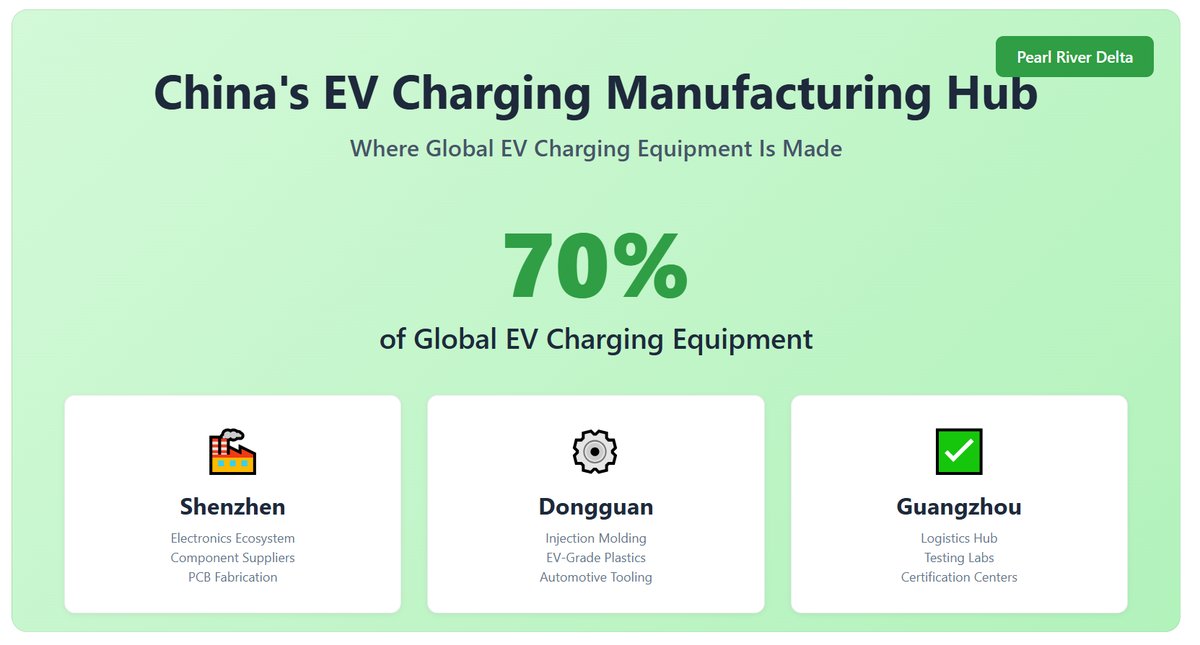
China's Pearl River Delta — specifically Dongguan, Shenzhen, and Guangzhou — produces roughly 70% of the world's EV charging equipment. If you're sourcing EV charging cables, connectors, portable chargers, or wallbox components, this region is where the manufacturing happens.
But with thousands of electronics factories claiming EV capabilities, how do you find one that actually understands automotive-grade requirements? After working with Pearl River Delta manufacturers for over a decade in electronics manufacturing and quality management, here's what separates real EV charging suppliers from electronics assemblers trying to break into the market.
Why the Pearl River Delta for EV Charging?
This region dominates EV charging manufacturing for specific reasons:
Shenzhen's electronics ecosystem: Component suppliers, cable assemblies, and PCB fabrication are all within 50km. Need a custom cable harness with TUV-certified connectors? Your supplier can source, assemble, and test it without crossing provincial lines.
Dongguan's injection molding cluster: EV-grade plastics (PC, PPO, PBT) with UL94 V-0 flame ratings are standard here. The mold makers understand automotive tolerances — ±0.05mm for connector housings, IP67 sealing requirements, and high-cycle durability testing.
Automotive supply chain maturity: BYD's presence in Shenzhen and surrounding EV manufacturers have elevated quality standards across the region. Suppliers that cut their teeth on automotive electronics understand what "automotive-grade" actually means: not just meeting specs on paper, but surviving 10+ years of daily use.
Certification infrastructure: TUV Rheinland, UL, Intertek, and other testing labs maintain local offices. This cuts certification cycles from 6 months to 3-4 months and allows for faster iteration when test failures occur.
What Makes EV Charging Manufacturing Different
EV charging equipment isn't consumer electronics. It's automotive-grade electrical equipment operating at 32A-80A for years, often outdoors in temperature extremes. The engineering gap between phone chargers and EV chargers is vast:
Consumer Electronics vs Automotive-Grade EV Charging
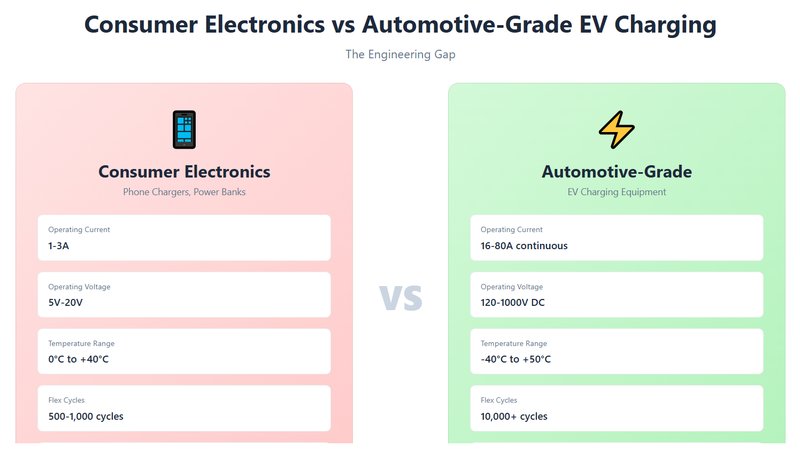
Consumer vs Automotive Standards
| Specification | Consumer Electronics | Automotive-Grade EV Charging |
|---|---|---|
| Operating Current | 1-3A | 16-80A continuous |
| Operating Voltage | 5V-20V | 120V-240V AC / 200V-1000V DC |
| Temperature Range | 0°C to +40°C | -40°C to +50°C (cable can reach +70°C under load) |
| Flex Cycle Durability | 500-1,000 cycles | 10,000+ cycles required |
| UV Resistance | Not required (indoor use) | 2,000+ hours UV exposure rating |
| IP Rating | IP20-IP44 (basic splash) | IP55-IP67 (outdoor weatherproof) |
| Safety Certification | CE, FCC (self-declared) | UL 2251/2594, IEC 62752, TUV (third-party tested) |
| Conductor Size | 0.5-0.75mm² | 2.5-10mm² (depends on current rating) |
| MTBF (Mean Time Between Failures) | 2-3 years | 10+ years |
| Quality Standard | ISO 9001 (basic) | IATF 16949 (automotive) preferred |
Key Takeaway: A factory making USB cables or power banks lacks the engineering systems, testing equipment, and quality controls for automotive-grade EV charging.
Cable Requirements
- Flex cycle durability: 10,000+ bending cycles without conductor breakage
- UV resistance: Outdoor cables must withstand 2,000+ hours of UV exposure without jacket cracking
- Temperature range: -40°C cold start capability to +50°C sustained operation (cable temperature can exceed ambient by 20°C under load)
- Conductor sizing: Proper ampacity calculations accounting for bundling, ambient temperature, and voltage drop over cable length
A factory making USB cables will spec 0.75mm² conductors. An EV charging cable requires 6mm² (for 32A) with specific strand counts for flexibility.
Connector Manufacturing Standards
- IP rating: IP55 minimum for indoor use, IP67 for outdoor applications
- Insertion/extraction force: 50N-100N insertion force, measured across 10,000 cycles
- Contact resistance: <0.5mΩ per pin, stable across temperature cycling
- Locking mechanism durability: Mechanical or electronic locks must survive 10,000 operations without degradation
Consumer electronics connectors are press-fit assemblies. EV connectors require precision machining, silver-plated copper contacts, and multi-cavity injection molds with tight tolerances.
Safety Certifications That Matter
For Western markets, certifications aren't optional. Distributors and installers face liability if equipment lacks proper certification:
- UL 2251 (USA): EV charging cables and connectors
- UL 2594 (USA): EV charging stations (EVSE)
- IEC 62752 (International): In-cable control and protection device (IC-CPD)
- CE marking (Europe): LVD (Low Voltage Directive), EMC (Electromagnetic Compatibility) directives
- TÜV certification (Europe/Global): Third-party verification beyond self-certified CE
A reliable supplier will have certification reports you can verify directly with the certification body. Many factories claim "CE certified" but cannot produce a valid test report or declaration of conformity.
Red Flags When Evaluating Suppliers
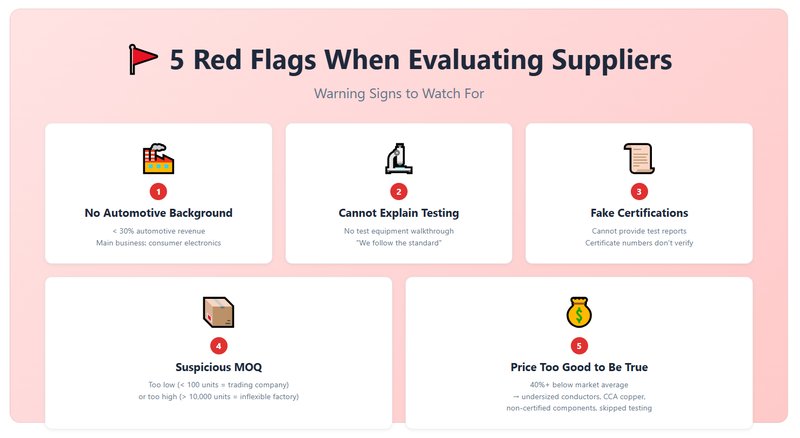
Red Flags to Watch
After working with hundreds of electronics manufacturers, here are the red flags that indicate a supplier isn't ready for automotive-grade EV charging:
1. No Automotive Background
If their main business is consumer electronics (power banks, Bluetooth speakers, USB accessories), they lack the quality systems for automotive applications. Ask: "What percentage of your revenue comes from automotive clients?" If it's under 30%, proceed with caution.
2. Cannot Explain Their Testing Procedures
A competent EV charging supplier will describe:
- High-current loop resistance testing
- Temperature rise testing under sustained load
- Insertion/extraction force testing across temperature extremes
- Cable flexing endurance testing (10,000+ cycles)
- UV aging chambers and thermal shock testing
If they say "we follow the standard" without detailing actual test procedures, they're likely outsourcing testing or skipping it entirely.
3. Certification Claims Without Documentation
Request:
- Full test reports (not just certificates)
- CB test certificates with national differences applied
- Manufacturer's Declaration of Conformity for CE marking
- Factory inspection reports from certification bodies
Verify certification numbers directly with UL, TUV, or Intertek. Certificate forgery is common enough that verification is standard practice.
4. MOQ Red Flags
Be cautious of extremely low MOQs (under 100 units) from factories claiming automotive capabilities. Automotive-grade tooling, testing equipment, and quality systems require volume to justify investment. Exception: factories with established automotive product lines adding EV charging to their portfolio.
Conversely, be cautious of rigid high MOQs (10,000+ units) without flexibility. It often indicates a factory focused on high-volume consumer goods, not the 500-2,000 unit runs typical of regional EV charging distributors.
5. Price That's Too Good to Be True
If a quote is 40%+ below market average, ask why. Common issues:
- Undersized conductors (6mm² quoted, 4mm² delivered)
- Lower-grade copper (CCA — copper-clad aluminum — instead of pure copper)
- Non-certified components (connectors without UL/TUV approval)
- Skipped testing procedures
What to Look for in a Reliable Supplier
Factory Capabilities That Matter
In-house cable extrusion or qualified cable suppliers: Ask if they extrude their own cable jackets or source from automotive-qualified cable suppliers. Certified cable suppliers (e.g., Tekpro, ACOME) are a positive sign.
Connector supply chain: Are they using Phoenix Contact, ITT Cannon, HUBER+SUHNER, or other tier-1 connector suppliers? Or are they sourcing from unknown connector factories without certifications?
Testing equipment investment: Walk through their testing lab (virtually or in person). Look for:
- High-current test stations (up to 80A continuous)
- Temperature chambers (-40°C to +85°C)
- Cable flexing test rigs
- Insertion/extraction force test stands
- Insulation resistance testers (megger testers)
Quality management system: ISO 9001 is baseline. Better: IATF 16949 (automotive quality management). This indicates they understand automotive failure modes and prevention systems (FMEA, control plans, PPAP).
Documentation Standards
A professional supplier will provide:
- Detailed technical data sheets with test data, not just marketing specs
- 2D drawings with tolerances for mechanical components
- Material certifications (RoHS, REACH compliance)
- Component traceability (can they trace a failed unit back to specific material lots?)
Communication and Engineering Support
Evaluate their engineering competency during initial conversations:
- Do they ask about your target market's electrical standards (120V/240V for North America, 230V/400V for Europe)?
- Do they clarify which connector standard you need (Type 1 for North America, Type 2 for Europe, CCS1/CCS2 for DC fast charging)?
- Can they explain the difference between Mode 2 and Mode 3 charging cables?
If they simply say "we can make it" without asking clarifying questions, they lack domain knowledge.
The Factory Audit Checklist
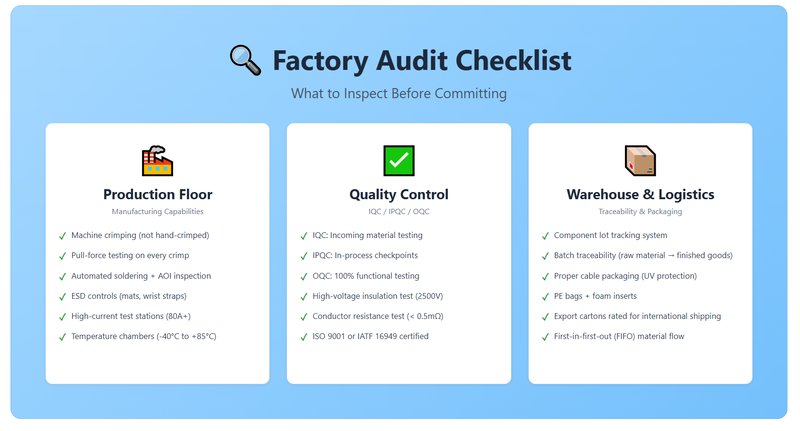
Factory Audit Checklist
Before committing to a supplier, conduct a factory audit (in-person or via detailed video call). Key areas to evaluate:
Production Floor
- Cable assembly stations: Are cables hand-crimped or machine-crimped? Machine crimping with pull-force testing is more consistent.
- Soldering quality: For PCB assemblies, look for automated soldering with AOI (automated optical inspection).
- ESD controls: ESD mats, wrist straps, and ionizers should be standard in electronics assembly areas.
Quality Control
- IQC (Incoming Quality Control): Do they test incoming cables, connectors, and components before production?
- IPQC (In-Process Quality Control): Are there quality checkpoints during assembly, or just final inspection?
- OQC (Outgoing Quality Control): What percentage of finished units undergo full functional testing? (Should be 100% for EV charging equipment.)
Warehouse and Logistics
- Component traceability: Are materials lot-tracked? In case of a field failure, can they identify which production batch was affected?
- Packaging standards: EV charging cables require protection from UV exposure, physical damage, and moisture during shipping. Look for proper inner packaging (PE bags, foam inserts) and outer cartons rated for international shipping.
How We Approach Supplier Selection at PearlGate
At PearlGate, we leverage an 11-year background in electronics manufacturing and quality management at BYD to vet suppliers. Our process:
- Initial screening: Verify certifications directly with issuing bodies (UL, TUV, Intertek).
- Factory audit: On-site evaluation of production capabilities, testing equipment, and quality systems.
- Sample validation: Full testing of samples through third-party labs before committing to production orders.
- Ongoing quality monitoring: Periodic audits and batch testing to ensure consistency.
We focus on the Pearl River Delta because we can conduct in-person audits, maintain direct relationships with factory engineering teams, and respond quickly when issues arise. For distributors in North America, Europe, the Middle East, and Australia, this local presence translates to faster problem resolution and reliable supply chains.
Final Recommendations
Start small, validate thoroughly: Even with a vetted supplier, start with a pilot order (100-500 units) and conduct field testing before scaling to 1,000+ unit orders.
Verify certifications independently: Don't rely on certificates provided by the supplier. Contact UL, TUV, or Intertek directly with the certificate number and verify validity.
Understand the supply chain: Ask suppliers about lead times for certified connectors, cable materials, and testing. Supply chain visibility prevents surprises during production.
Build relationships, not just transactions: The best supplier relationships are partnerships. A supplier who understands your target market's requirements and proactively flags potential issues is worth more than a 10% price discount.
Ready to Source EV Charging Equipment?
If you're a distributor or installer looking for reliable EV charging suppliers in China, we can help. With over a decade of experience in Pearl River Delta manufacturing and direct relationships with automotive-qualified factories, we handle supplier vetting, factory audits, and quality oversight so you can focus on your market.
Explore our solutions:
- Portable EV Chargers - Level 2 charging for home and travel use
- EV Charging Cables - Type 1, Type 2, CCS1, CCS2 certified cables
- OEM Manufacturing Services - Custom branding and specifications
- Factory Verification Program - Third-party audits and quality control
Learn more about EV charging standards:
- CCS1 vs CCS2: Key Differences Explained - Understand connector standards
- CE vs UL Certification for EV Chargers - Compliance requirements
- EV Charging Cable Buying Guide - How to choose the right cable
Contact us to discuss your EV charging equipment requirements. We'll connect you with suppliers who meet Western certification standards and can deliver consistent quality at scale.
Frequently Asked Questions
Q: How long does it take to vet a new supplier in China?
A: A thorough supplier vetting process typically takes 4-6 weeks:
- Week 1: Initial screening and certification verification (remote)
- Week 2: Factory audit scheduling and documentation review
- Week 3: On-site factory audit (or detailed video audit)
- Week 4-6: Sample production, testing, and validation
For urgent projects, a compressed 2-week assessment is possible but may miss critical red flags.
Q: What's a reasonable MOQ for EV charging equipment?
A: MOQs vary by product type:
- Portable EV chargers: 100-500 units (typical for initial orders)
- EV charging cables: 200-1,000 units
- Wallbox chargers: 50-200 units
- DC fast chargers: 10-50 units (higher unit value justifies lower MOQ)
Be cautious of factories claiming MOQs under 50 units for portable chargers — it often indicates they're trading companies, not manufacturers.
Q: Can I trust certification documents provided by Chinese suppliers?
A: Not always. Certificate forgery is common enough that independent verification is standard practice. Always:
- Request the full test report (not just the certificate)
- Verify the certificate number directly with the issuing body (UL, TUV, Intertek)
- Check that the certificate matches the exact product model you're ordering
- Confirm the factory name on the certificate matches the manufacturer
Legitimate suppliers expect this verification and will provide contact information for certification bodies.
Q: What's the typical lead time for OEM EV charging products?
A: Standard lead times (after order confirmation):
- Sampling: 2-3 weeks
- Tooling/mold making (if needed): 4-6 weeks
- Certification (if product is new): 8-12 weeks
- Mass production: 4-6 weeks (for 500-2,000 units)
Total time from initial contact to first shipment: 3-6 months for new products with certifications, 6-8 weeks for existing certified products.
Q: Should I use a sourcing agent or work directly with factories?
A: Both approaches have merits:
Direct factory relationship (recommended if you have):
- Technical knowledge to evaluate manufacturing capabilities
- Ability to conduct factory audits (in-person or remotely)
- Volume justifying direct communication (500+ units/year)
Sourcing agent/partner (recommended if you):
- Lack technical background in electronics manufacturing
- Cannot visit China for audits
- Need help with quality control and logistics
- Are making initial market entry (under 500 units/year)
At PearlGate, we act as a technical partner rather than a traditional sourcing agent — we don't just connect you with factories, we verify their capabilities and monitor quality because we understand automotive-grade requirements.
Q: What questions should I ask suppliers during initial contact?
A: Key qualifying questions:
Technical capabilities:
- "What percentage of your revenue comes from automotive clients?"
- "Can you explain your high-current testing procedures?"
- "Do you extrude cables in-house or source from certified suppliers?"
Certification and compliance:
- "Can you provide full UL/CE test reports (not just certificates)?"
- "Have you passed factory audits from certification bodies?"
- "What's your process for handling certification updates?"
Quality systems:
- "What quality management system do you follow (ISO 9001, IATF 16949)?"
- "What percentage of finished units undergo functional testing?"
- "Can you provide traceability documentation for materials?"
If they cannot answer these questions clearly, they're likely not ready for automotive-grade production.
Q: How do I protect my IP when working with Chinese manufacturers?
A: Practical IP protection strategies:
-
NDA (Non-Disclosure Agreement): Have a Chinese-language NDA reviewed by a China-focused IP lawyer. U.S./EU NDAs are often unenforceable in China.
-
Trademark registration: Register your brand in China before sharing designs. It's first-to-file, not first-to-use.
-
Design ownership: Clarify in contracts who owns tooling, molds, and design files.
-
Controlled information sharing: Don't share more than necessary. For example, provide mechanical drawings without revealing proprietary PCB layouts if possible.
-
Multiple supplier strategy: For critical components, work with more than one supplier to reduce dependency.
For most B2B distributors sourcing standard EV charging equipment, IP risk is moderate. The bigger risk is quality consistency and certification validity.
About PearlGate: We specialize in connecting North American, European, Middle Eastern, and Australian distributors with certified EV charging equipment manufacturers in China's Pearl River Delta. Our background in automotive electronics manufacturing and quality management ensures your suppliers meet the stringent requirements of the EV charging industry.
Sourcing EV Charging Equipment from China?
I'm based in the Pearl River Delta with 12 years of supply chain experience. I help buyers find verified EV charging manufacturers, verify certifications, and coordinate factory visits.
Subscribe for more guides like this
Get sourcing tips and new factory alerts. Free, no spam.
No spam. Unsubscribe anytime.