Common EV Charging Cable Problems (And How to Spot One That Won't Melt)
Search any EV owner forum and you'll find the same horror story on repeat: a charging cable that got "too hot to touch," a connector that melted into the car's charge port, or a $300 Amazon cable that died after three months. One charging engineer's PSA on r/electricvehicles put it bluntly:
"The cheap charging cords on Amazon have serious issues and may melt your car's charge port. Don't buy or use them."
Another owner, after a connector melted at the J1772 plug:
"Melted one guy's port on his car. Damaged at least another. Not a great sign."
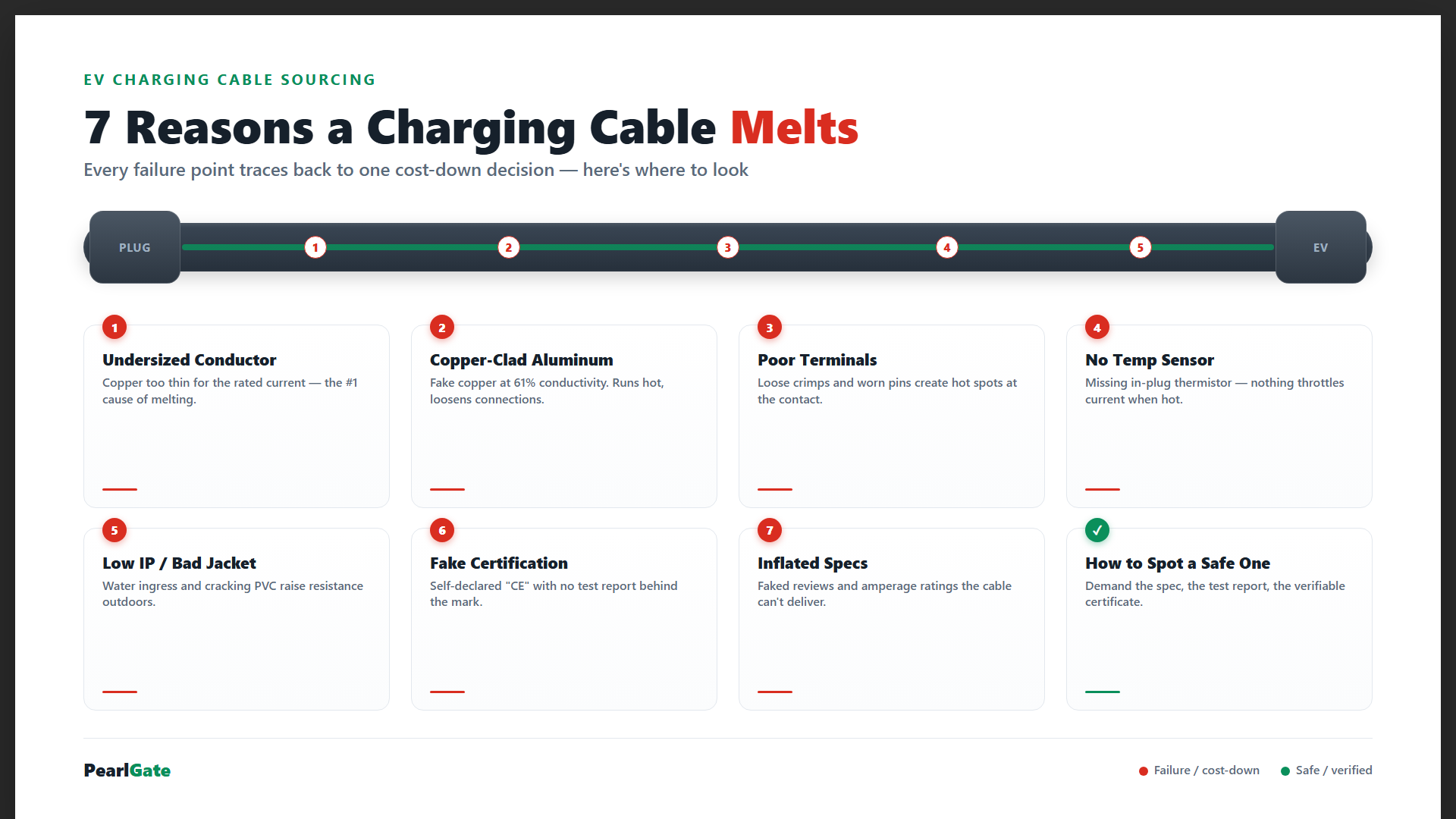
Here's the uncomfortable truth: a charging cable melting is almost never bad luck. It's physics meeting a cut corner somewhere in the bill of materials. After 11 years managing manufacturing and quality for electronics at BYD, I can tell you that every melted connector traces back to a decision someone made to save a few cents — thinner copper, a cheaper terminal, a missing temperature sensor.
This guide breaks down the 7 most common EV charging cable problems, the engineering reason behind each one, and a practical checklist you can use to spot a cable that won't fail — whether you're an EV owner buying one cable or a distributor sourcing ten thousand.
Figure 1: The seven failure points where EV charging cables most commonly go wrong
Why EV Charging Cables Run Hot in the First Place
Before the problems, the physics. Heat in any cable comes from one equation:
Power lost as heat (W) = Current² × Resistance (P = I²R)
Two things matter here:
- Current is squared. Doubling the current quadruples the heat. An EV charging at 32A generates far more than twice the heat of one at 16A.
- Resistance is the variable a manufacturer controls. Thicker copper, cleaner terminals, and tight connections all lower resistance. Every one of them costs money.
EV charging is also a continuous load — it runs for hours at near-constant current. The US National Electrical Code (NEC Article 625) treats EV charging exactly this way: section 625.42 requires the branch circuit and equipment to be rated for 125% of the charger's continuous current. A cable that feels fine for a 10-minute test can still cook itself over a 6-hour overnight charge. This is why charging cables fail in ways that phone chargers never do.
A cable getting slightly warm is normal. A cable that's hot enough to be uncomfortable to hold, or that smells of hot plastic, is failing.
Problem 1: Undersized Conductors (The #1 Cause of Melting)
This is the single most common reason cheap cables melt. The conductor — the copper inside — is too thin for the current it carries.
Wire is sized by gauge (AWG); a lower number means thicker copper and lower resistance. Quality flexible charging cables use high-temperature insulation (TPE/TPU rated 90–105°C), so they carry more current per gauge than ordinary building wire. As a practical guide to the conductor you should expect inside a well-built flexible charging cable:
| Charging Current | Typical Copper Conductor (quality cable) | Common "Cheap Cable" Shortcut |
|---|---|---|
| 16A (Level 1/2) | 14 AWG (2.5 mm²) | 16–18 AWG |
| 32A (Level 2) | 10 AWG (4–6 mm²) | 12–14 AWG |
| 40A (Level 2) | 8 AWG (6 mm²) | 10 AWG |
| 48A (Level 2) | 8 AWG (6–10 mm²) | 10 AWG |
A cable advertised as "40A" but built with 10 AWG instead of 8 AWG will work on a quick test and slowly overheat in real use. The buyer has no way to see this from the outside — the jacket looks identical.
Important — two different cables, two different rules. Don't confuse the flexible charging cable (the cordset, sized under NEC Table 400.5 with high-temp insulation) with the hardwired supply wiring that feeds a wall-mounted unit. The supply circuit is sized under NEC 625.42 at 125% of continuous current and is usually one or two sizes larger — a 48A hardwired charger typically needs 6 AWG building wire on a 60A breaker. The table above is for the cable itself. Final sizing always follows the manufacturer's rating, the cable's insulation temperature class, and local code.
Engineer's note: The jacket diameter tells you nothing. Manufacturers pad thin copper with thick insulation to make a cable look heavy-duty. The only honest spec is the conductor cross-section in mm² or AWG, stated on the cable and backed by a test report.
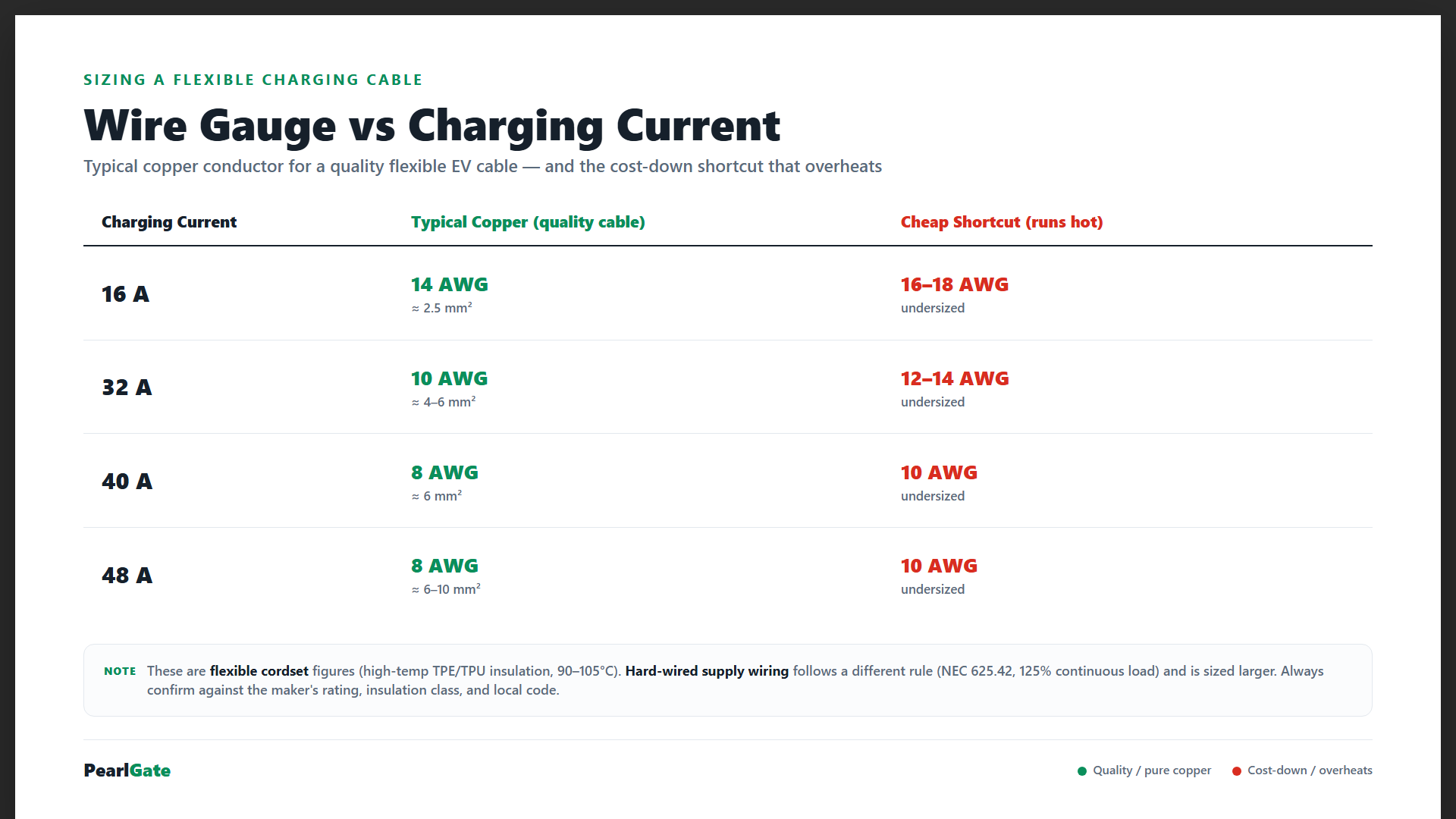
EV charging cable wire gauge requirements by current: 32A needs 10 AWG copper
Problem 2: Copper-Clad Aluminum (CCA) Instead of Pure Copper
This is the dirtiest trick in the cable industry. CCA is an aluminum wire with a thin copper coating. It looks like copper, passes a quick visual check, and costs roughly 40% less.
The problem: aluminum has about 61% the conductivity of copper. A CCA cable carrying the same current runs significantly hotter, and aluminum also expands and contracts more with heat — loosening connections over time until a hot spot forms at a terminal.
For EV charging — a high-current continuous load — CCA is genuinely dangerous. Reputable EV cables use oxygen-free pure copper. CCA should be an automatic disqualification.
How to check: Ask for the conductor material spec in writing. A pure-copper cable will say so. A vague answer ("high-quality copper alloy") is a red flag. A simple field test: pure copper is denser, so a genuine copper cable of the same gauge is noticeably heavier.
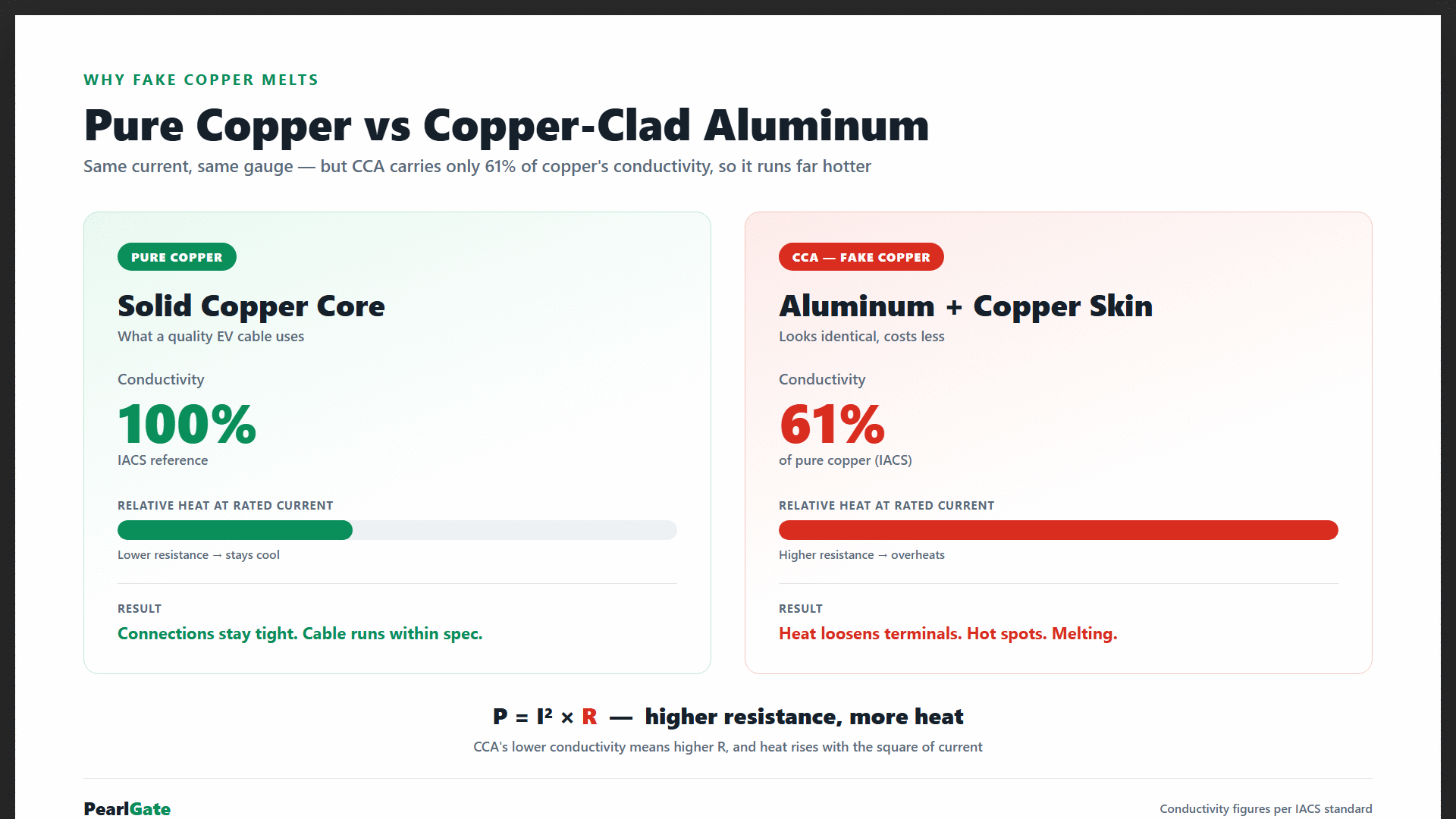
Pure copper vs copper-clad aluminum EV cable: CCA has only 61% conductivity and runs hotter
Problem 3: Poor Terminal and Contact Quality
Most melted connectors don't fail in the middle of the cable — they fail at the contact points: where the pins meet the car's port, or where the conductor crimps to the plug pin.
Every connection adds contact resistance. As the P = I²R physics above shows, resistance makes heat. A loose crimp, an under-plated pin, or a spring contact that has lost its tension creates a localized hot spot that can hit 100°C+ while the rest of the cable stays cool.
This is exactly what owners describe when they say the cable melted "at the plug" but the cord was fine. The MUSTART connector failures and the various "melted in the port" forum threads are nearly all contact-resistance failures.
Quality factors that prevent this:
- Silver or high-grade nickel plating on the contact pins (not bare brass)
- Proper crimp tooling and pull-test verification on every terminal
- Spring-contact design that maintains pressure over thousands of plug cycles
These are invisible to the buyer and the first things a cost-down supplier removes.
Problem 4: Missing or Fake Temperature Sensor
Quality J1772 and NACS connectors contain a thermistor (temperature sensor) inside the plug. When the contact temperature climbs toward a danger threshold, the EVSE control board throttles the current (foldback) or stops charging entirely. This is the last line of defense that prevents a hot spot from becoming a melted port.
Cheap cables save cost two ways:
- Omit the sensor entirely — no thermal protection at all.
- Fit a sensor that isn't wired into a real protection circuit — it exists for the photo, but nothing acts on its reading.
When you see a forum post where "the charger shut itself off when it got hot," that's a good cable doing its job. When you see "it just kept going until it melted," that's a missing or fake sensor.
How to verify: Ask the manufacturer directly: "Is there an in-connector temperature sensor, and does the control board perform current foldback on over-temperature?" A serious supplier answers immediately and can show it on the schematic and in test data.
Problem 5: Inadequate IP Rating and Jacket Material
EV cables live outdoors. They get rained on, driven over, dragged across concrete, and coiled in freezing and baking temperatures. Two specs govern survival:
- IP rating — ingress protection against water and dust. For an outdoor connector, IP55 is a minimum; IP65–IP67 is what serious products carry. Water reaching a live contact causes corrosion, which raises resistance, which brings us back to heat.
- Jacket material — cheap PVC jackets harden and crack in cold and soften in heat. Quality cables use TPU or TPE rubber jackets rated across a wide temperature range (typically −30°C to +50°C) and rated for UV and abrasion.
A cracked jacket lets water in and exposes conductors. A stiff cold-weather cable is also more likely to be yanked at the connector, accelerating contact wear.
Problem 6: No Real Safety Certification
This is the one that separates a real product from a gamble. Genuine certification means an independent lab has tested the cable to a recognized standard:
| Market | Cable / EVSE Standard | What It Covers |
|---|---|---|
| North America | UL 2594 / UL 2251 / UL 62 | EVSE, connectors, and flexible cord safety |
| Europe | IEC 62196 + CE (TÜV-tested) | Connector dimensions, safety, EMC |
| Australia | CE / RCM + IEC 62196 | Connector and electrical safety |
The trap: many cheap cables are self-declared — the box says "CE" but there's no test report from a Notified Body behind it. A self-declared CE mark is worthless to a serious distributor and illegal to sell in many channels.
How to verify: Ask for the actual test report and certificate number, then check it against the certifying body's database (UL Product iQ, the TÜV certificate database). "We have CE" is a claim. A downloadable certificate with a verifiable number is proof.
Problem 7: Fake Reviews and Spec Inflation
Not an engineering failure, but it's how the bad cables reach buyers. The charging engineer's original PSA called it out directly: cheap cables fake their Amazon reviews and inflate their specs. A cable listed as "80A / 19kW" on a connector that physically cannot dissipate that heat is spec fiction.
Warning signs:
- Power or amperage ratings that seem too high for the price
- Hundreds of 5-star reviews appearing in a short window
- No named manufacturer, no certificate numbers, no test reports
- "Military grade," "premium copper alloy," and other unverifiable marketing language
If the listing makes claims it can't document, assume the cable can't back them up either.
The Buyer's Checklist: How to Spot a Cable That Won't Melt
Whether you're buying one cable or sourcing a container, run this list. It's the same logic a manufacturing quality team uses on incoming inspection.
Conductor
- Conductor cross-section stated in mm² / AWG, sized for the rated current (see Problem 1 table)
- Pure copper confirmed in writing — not CCA
- Cable weight is consistent with real copper content
Connector & contacts
- Silver or high-grade plated contact pins
- In-connector temperature sensor with current foldback confirmed on the schematic
- Rated for 10,000+ mating cycles
Environmental
- IP65 or higher on the connector
- TPU/TPE jacket rated for your climate's temperature range
- UV and abrasion rated for outdoor use
Compliance
- Real UL / CE (TÜV) / RCM certificate — number verifiable in the issuing body's database
- Full test report available, not a self-declaration
- Named, traceable manufacturer
Real-world fit
- Amperage rating matches your actual circuit (don't pay for 48A you can't use)
- Cable length suits your parking distance (longer cable = more resistance; size up the gauge accordingly)
If a seller can't produce documentation for the items above, that silence is your answer.
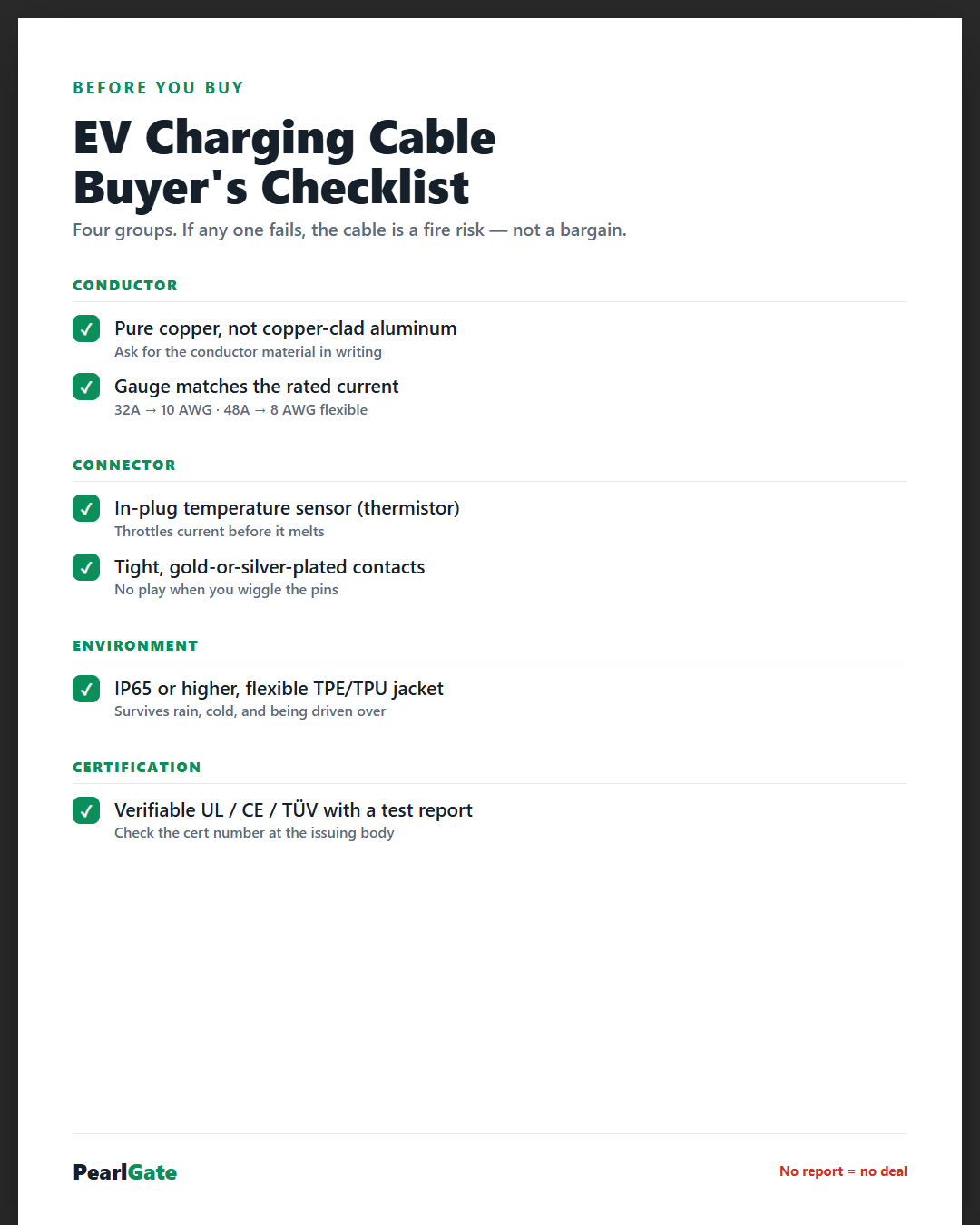
EV charging cable buyer checklist: pure copper, temperature sensor, IP65+, verifiable UL/CE certification
Frequently Asked Questions
Is it normal for an EV charging cable to get warm?
Mildly warm is normal — current through any conductor produces some heat. Hot enough to be uncomfortable to hold, or any smell of hot plastic, is not normal and means you should stop charging and inspect the cable and outlet.
Why did my charging cable melt at the plug but not the cord?
That's a contact-resistance failure (Problem 3). A loose crimp, worn spring contact, or under-plated pin creates a localized hot spot at the connector while the rest of the cable stays cool. It points to connector quality, not cable length.
Can a cheap charging cable damage my car?
Yes. The most severe failures melt the vehicle's charge port — an expensive repair — and in rare cases cause fires. The risk is highest with undersized conductors, CCA wire, and missing temperature sensors.
What gauge cable do I need for a 32A charger?
For continuous 32A charging, use no thinner than 10 AWG pure copper. Many cheap "32A" cables ship with 12–14 AWG, which is the leading cause of overheating at that current.
Is CCA (copper-clad aluminum) ever acceptable for EV charging?
No. Aluminum's lower conductivity and higher thermal expansion make CCA unsuitable for a high-current continuous load like EV charging. Insist on pure copper.
How do I verify a CE or UL mark is real?
Ask for the certificate number and the test report, then look the number up in the issuing body's public database (UL Product iQ, TÜV certificate database). A self-declared mark with no verifiable certificate should be treated as no certification.
Does a longer charging cable overheat more easily?
It can. A longer cable has more total resistance, so it runs slightly hotter at the same current. A well-made long cable compensates with a thicker conductor. A cheap long cable keeps the thin conductor and runs hot.
The Bottom Line
EV charging cables don't melt because of bad luck. They melt because of undersized copper, CCA shortcuts, poor terminals, missing temperature sensors, and fake certifications — every one a deliberate cost-down decision. The good news: each failure mode is detectable before you buy, if you know which spec to demand and how to verify it.
For an EV owner, that means refusing to buy on price and reviews alone. For a distributor, it means treating documentation — conductor spec, test reports, verifiable certificates — as non-negotiable, because your customers' melted ports become your returns and your reputation.
Related Articles
- Why 120V EV Charging is So Slow (And When to Upgrade to 240V)
- How to Choose an EV Charging Cable: Buyer's Guide
- Reliability First: Type B RCD, IP67, and Why B2B Buyers Stopped Buying Cheap
- How to Find Reliable EV Charging Suppliers in China
Sourcing Cables That Pass This Checklist?
At PearlGate, we help overseas distributors and installers source EV charging cables and equipment that actually pass the checklist above. Every product is backed by verifiable UL, CE (TÜV), and RCM certification, full test reports, and on-site factory verification — drawing on 11+ years of electronics manufacturing and quality engineering experience.
For distributors: We offer OEM/ODM cables and connectors with pure-copper conductors, in-connector thermal protection, and IP67-rated housings, built for the North American, European, Middle Eastern, and Australian markets.
Request a Sample | View Our Product Line
Last updated: June 18, 2026 Reading time: 11 minutes
Sourcing EV Charging Equipment from China?
I'm based in the Pearl River Delta with 12 years of supply chain experience. I help buyers find verified EV charging manufacturers, verify certifications, and coordinate factory visits.
Subscribe for more guides like this
Get sourcing tips and new factory alerts. Free, no spam.
No spam. Unsubscribe anytime.