Reliability First: Type B RCD, IP67, and Why B2B Buyers Stopped Buying Cheap EV Chargers
A few years ago, sourcing an EV charger came down to one number: the unit price. In 2026, that conversation has changed. The buyers placing repeat orders — fleet operators, regional distributors, retail chains — have learned the hard way that the cheapest charger on the quote sheet is often the most expensive one to own.
The reason is simple. A charger that trips offline, fails in the rain, or gets returned at 8% doesn't save you 20%. It costs you the margin, the reseller relationship, and the reorder. Reliability has quietly become the variable that decides B2B deals, and the spec sheet that wins them is no longer about watts. It's about three things most cheap factories can't deliver: the right residual-current protection, a real ingress rating, and certification depth you can actually verify.
This guide breaks down what "reliability" means at the component level, why it matters for resale, and — the part most supplier-comparison articles skip — how to verify it on the factory floor before you place a PO.
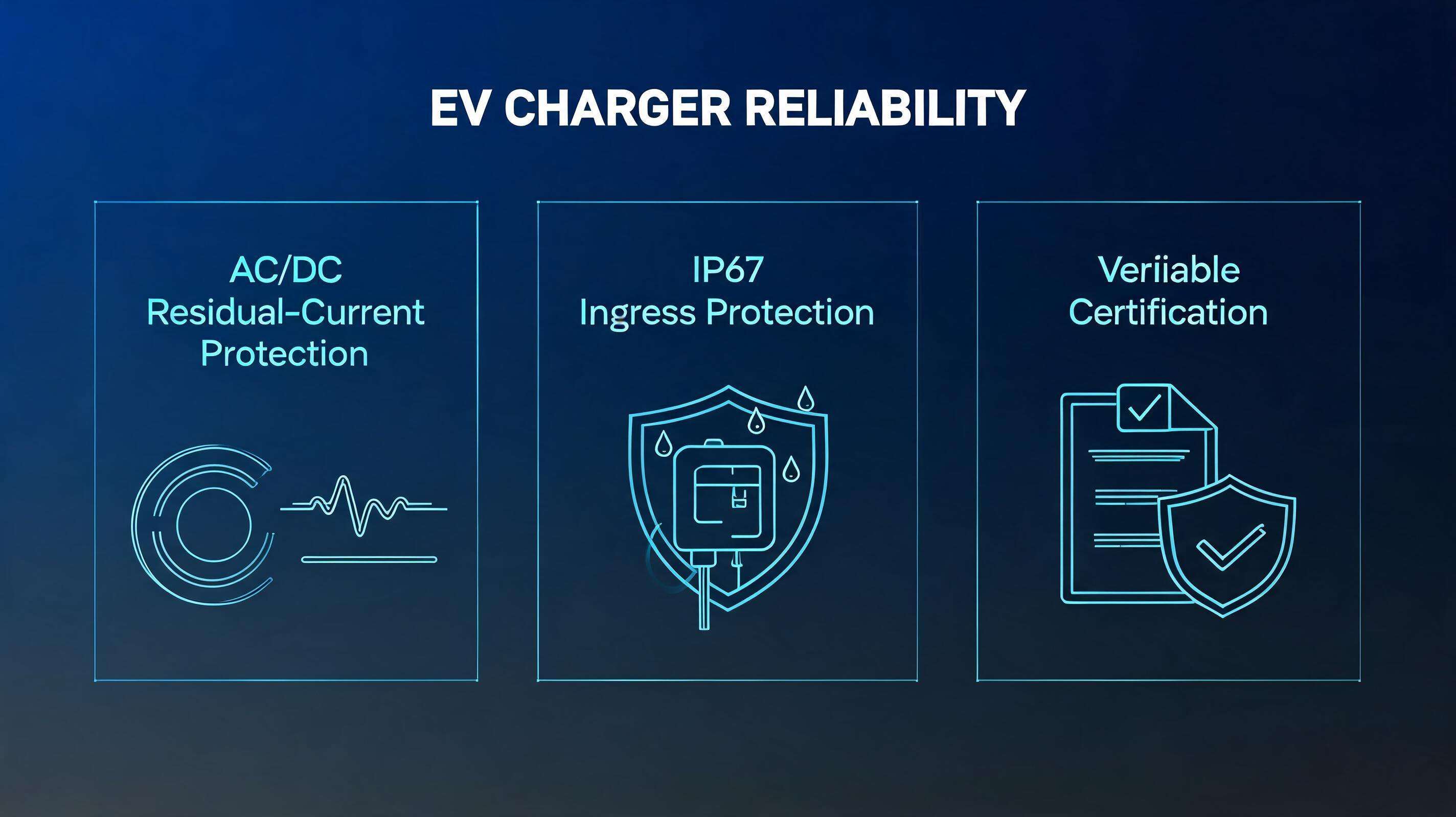
The three reliability pillars B2B buyers now spec: AC/DC residual-current protection (Type B / RDC-DD), IP67 ingress protection, and verifiable third-party certification.
The Market Context: Why "Cheap" Stopped Selling
The EV charging hardware market is large enough that quality variance now has real commercial consequences. The global EV charging equipment market is valued at roughly US$19.5 billion in 2026 and is projected to reach US$89.3 billion by 2033, a 24.3% CAGR (Persistence Market Research). Level 2 is the workhorse category — about 33.1% of the market in 2026 — and residential is the dominant end-use at 52.4%, with North America the leading region at 31.7%.
The product line closest to most importers — portable Level 2 chargers — is growing even faster in relative terms: from US$1.65 billion in 2025 to a projected US$6.69 billion by 2034, a 16.85% CAGR (Straits Research). In Europe, the charging equipment market runs from US$9.87 billion in 2026 to US$17.92 billion by 2031 (Mordor Intelligence), where Level 2 already held 46.85% share in 2025.
What does a growing market have to do with reliability? Two things. First, as volume scales, so does the return rate of low-quality units — and returns are visible to your downstream channel in a way they never were at small volume. Second, a maturing market means buyers have history. They've been burned, they compare notes, and they now ask the questions a 2022 buyer didn't know to ask. (Picking the right connector standard is the other half of that conversation — see our CCS1 vs CCS2 sourcing guide.) The first of those questions is about residual-current protection.
Reliability Pillar 1: Type B RCD / RDC-DD — The Safety Core
This is the single most important — and most commonly cut — reliability feature in a cheap EV charger.
What an RCD actually does
A Residual Current Device (RCD) monitors the difference between the current flowing out on the live conductor and back on the neutral. If those don't match, current is leaking somewhere it shouldn't — through a person, through a fault — and the RCD trips. Standard household RCDs come in types defined by IEC 60755:
-
Type AC — trips on AC sinusoidal residual current only.
-
Type A — trips on AC and pulsating DC residual current.
-
Type F — Type A, plus composite/high-frequency residual currents.
-
Type B — everything above, plus smooth (pure) DC residual current, defined in IEC 62423.
Why EV charging breaks ordinary RCDs
Here's the problem unique to EV charging. The power electronics inside an EV's on-board charger can produce a smooth DC fault current. And a smooth DC current does something dangerous to a Type AC or Type A device: it saturates the magnetic core of the detector. Once the core is saturated, the device is effectively blinded — it can no longer detect even a dangerous AC fault. The industry term for this failure mode is DC blinding.
This isn't a marketing claim. The BEAMA RCD Handbook — cited in the standard reference literature on residual-current devices — states plainly that Types F and B were introduced "because some designs of types AC and A can be disabled if a DC current is present that saturates the core of the detector."
The two ways to do it right
There are two compliant approaches, and a sourcing buyer should know which one a charger uses:
- A Type B RCD (IEC 62423) — detects AC and smooth DC residual current directly.
- An RDC-DD — a Residual Direct Current Detecting Device, defined in IEC 62955 for Mode 3 charging (and IEC 62752 for Mode 2 / portable IC-CPD units). The RDC-DD detects DC fault current down to 6 mA and disconnects, allowing it to be paired with an upstream Type A RCD. This is the most common implementation built inside the charger.
As Hager's EV guidance puts it, an RDC-DD is built into the charging equipment to monitor and disconnect "should any DC problems appear on the AC side of the installation, which could affect the operation of RCDs."
Sourcing takeaway: A charger that protects against DC faults — whether via a Type B RCD or a built-in 6 mA RDC-DD (IEC 62955 / IEC 62752) — is doing the one job a cheap unit skips. This is the first line on the spec sheet to verify, not assume.
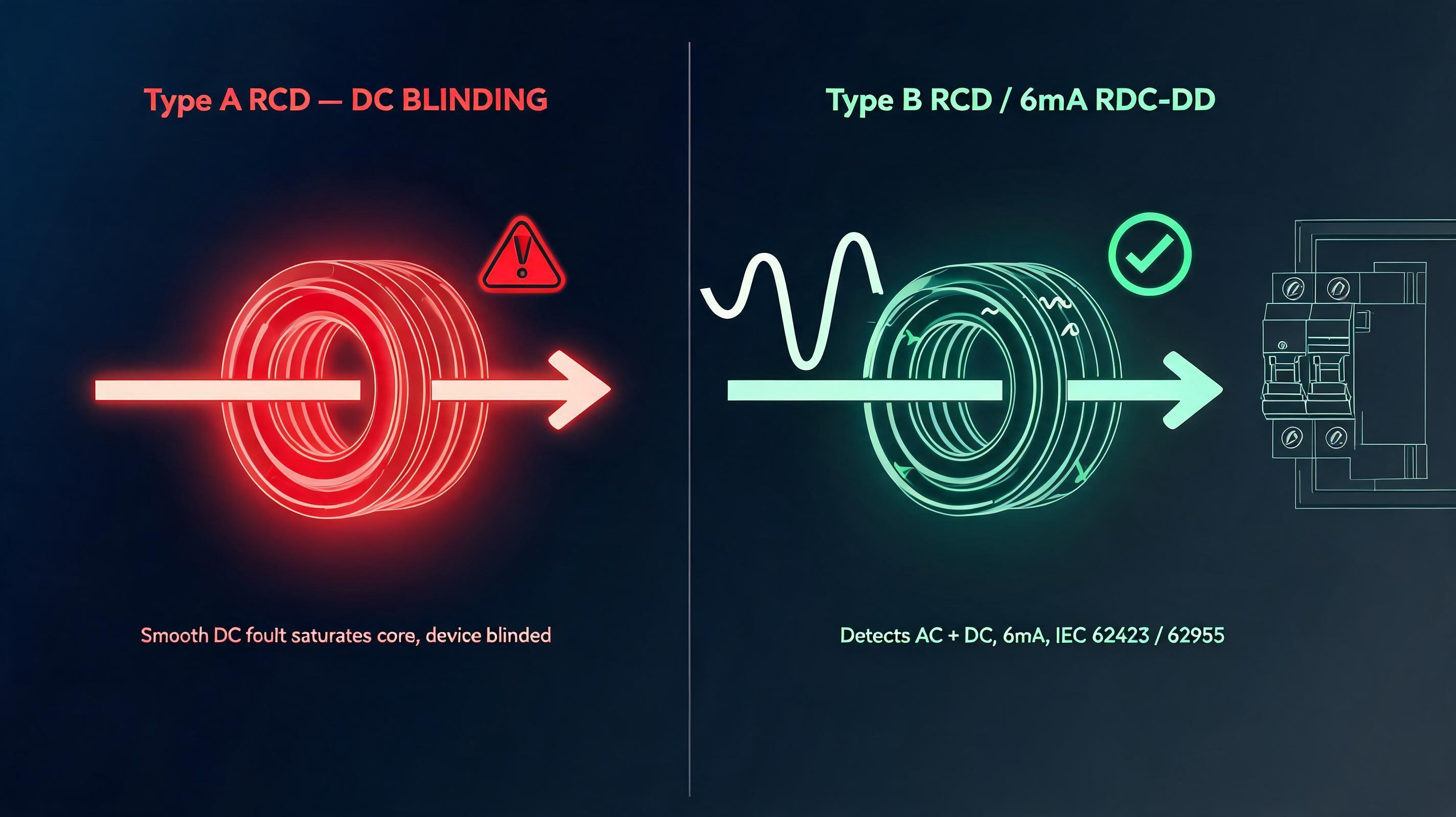
Type A core saturation DC blinding versus Type B RDC-DD operation diagram
Reliability Pillar 2: IP67 and Operating Temperature
The second pillar is physical durability, and it's where field returns are born.
Ingress protection, decoded
The IP (Ingress Protection) rating has two digits. The first is solids/dust; the second is water:
-
IP54 — dust-protected, splash-resistant. Common on bargain units.
-
IP65 — dust-tight, protected against water jets.
-
IP67 — dust-tight, and protected against temporary immersion up to 1 m.
For a portable charger that lives in a trunk, gets used at a campsite, or hangs on an outdoor wall through a winter, IP54 is a return waiting to happen. IP67 is the spec that survives the real world — and the one B2B buyers in coastal, rainy, or dusty markets now require by default. It's the rating we hold our portable EV chargers and charging cables to before they reach a buyer.
Temperature derating — the hidden failure
A spec sheet may say "up to 48 A," but the question is: at what ambient temperature, and for how long? Many low-cost units derate aggressively — a charger rated 48 A may quietly throttle to 32 A once the enclosure heats up, or trip on thermal protection during a long session. The connector and cable matter as much as the box: undersized conductors run hot, and heat is the number-one driver of melted connectors and warranty claims.
Sourcing takeaway: Ask for the sustained current rating at 40 °C ambient, not the peak. A unit that holds its rated current through a full session in summer heat is a different product from one that derates after ten minutes.
Reliability Pillar 3: Certification Depth You Can Verify
The third pillar is the one buyers most often take on faith — and shouldn't. "Certified" means nothing until you know which certification, issued by whom, and verifiable where.
The regional certification matrix
| Market | Mandatory / expected | Notes |
|---|---|---|
| North America | UL (e.g. UL 2594 for Level 2 EVSE), FCC Part 15 | "UL listed" is verifiable on UL's product iQ database |
| Europe / UK | CE (NB-issued), TÜV / Dekra report, RoHS | CE must trace to a Notified Body; check the NANDO database |
| Residual-current | IEC 62423 (Type B) / IEC 62955 (RDC-DD) / IEC 62752 (Mode 2) | The safety standards from Pillar 1 |
| Ingress | IP67 | Verify in the test report, not just the datasheet |
The two red flags
- "Tested to" is not "certified to." A factory can test a unit to a UL standard at a cheaper lab without ever holding an issued UL listing. Only an issued, listed certificate counts. Ask for the certificate number and verify it independently.
- The same certificate under three brands. If the identical CE or test report shows up behind multiple "different" suppliers, you're looking at one OEM and several relabelers — and you have no idea who actually controls the line.
Sourcing takeaway: Certification depth is the cheapest thing to fake on a quote and the most expensive thing to discover after a container lands. Verify the certificate number against the issuing body's database before you trust it. (For the wider picture on separating real factories from relabelers, see our guide on finding reliable EV charging suppliers in China.)
How to Verify Reliability Before You Place a PO
This is the part that separates a sourcing partner from a trading company. At PearlGate, the reliability claims above aren't taken from a datasheet — they're verified on the factory floor. Here's the checklist we run, drawn from 11 years of quality management at BYD, where the customers were Dell, Lenovo, Huawei, and Siemens, and "tested to" was never good enough.
1. Verify the residual-current protection physically. Ask to see the RDC-DD or Type B RCD component inside the unit, and ask for the 6 mA DC trip test to be demonstrated with an RDC-DD tester (Fluke / Metrel). A factory that protects against DC faults can show you. A factory that cut it will change the subject.
2. Confirm the IP rating in the test report. Don't accept "IP67" on a one-line datasheet. Ask for the IP test report, and confirm it covers the connector and cable gland, not just the enclosure.
3. Test current under sustained load, not peak. Request a sustained-load test at elevated ambient temperature. Watch for derating. The honest number is the one that holds after 30 minutes, not the one on the label.
4. Verify every certificate against its issuing body. UL listing → UL product iQ. CE → Notified Body on NANDO. Cross-check that the certificate holder is the factory you're buying from, not a relabeled twin.
5. Walk the line. Separate molding and assembly tooling, incoming-material inspection, end-of-line electrical test on 100% of units (not sampled). This is what a low return rate is actually made of.
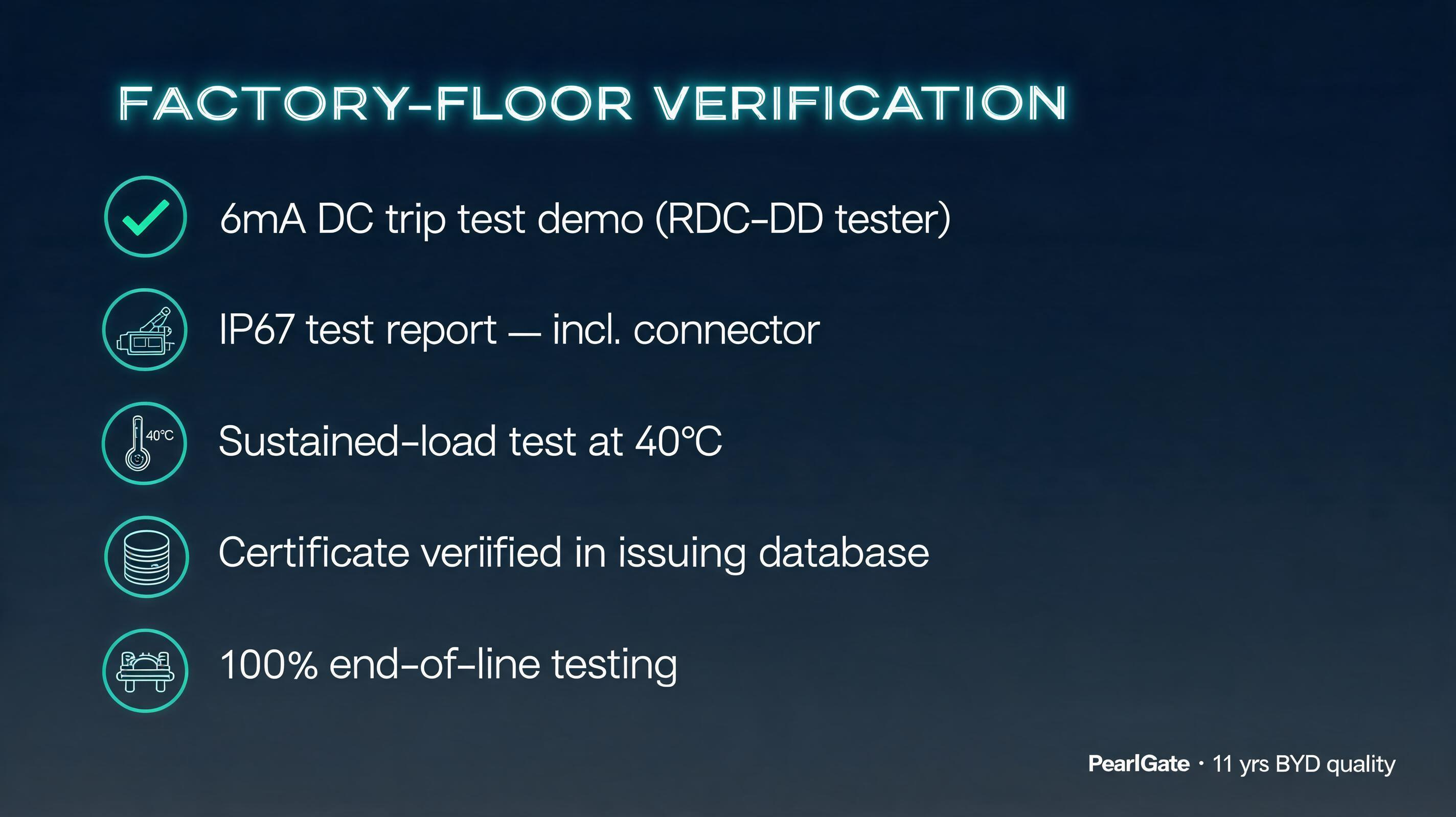
Factory-floor EV charger reliability verification checklist
Frequently Asked Questions
What is a Type B RCD, and why does an EV charger need one?
A Type B RCD (IEC 62423) trips on AC, pulsating DC, and smooth DC residual current. EV chargers can produce smooth DC fault current, which saturates and blinds ordinary Type AC/Type A devices ("DC blinding"). Without Type B protection — or an equivalent RDC-DD — a dangerous fault can go undetected.
What is an RDC-DD and how is it different from a Type B RCD?
An RDC-DD (Residual Direct Current Detecting Device, IEC 62955 for Mode 3 / IEC 62752 for Mode 2) detects DC fault current down to 6 mA and disconnects, letting it work alongside an upstream Type A RCD. It's usually built inside the charger and is the most common compliant implementation in portable and wall units.
Is IP67 necessary, or is IP65 enough?
IP65 is dust-tight and resists water jets; IP67 adds protection against temporary immersion. For portable chargers and outdoor wall units exposed to rain, dust, or coastal conditions, IP67 is the spec that prevents field returns. IP54 is not adequate for outdoor B2B deployment.
What does "tested to UL" vs "UL listed" mean?
"Tested to" means a unit was checked against a standard, possibly at a cheaper lab, without an issued listing. "UL listed" means UL issued a certificate you can verify on its product iQ database. Only an issued listing counts for the North American market.
Why do cheap EV chargers have higher return rates?
The most common causes are skipped DC residual-current protection (no RDC-DD/Type B), inadequate ingress protection (IP54 instead of IP67), aggressive thermal derating under sustained load, and undersized connectors/cables that overheat. Each is a corner cut to hit a lower price.
How can I verify a factory's reliability claims before ordering?
Demand a physical demonstration of the 6 mA DC trip test, the full IP67 test report (including connector), a sustained-load test at elevated temperature, and independent verification of every certificate against its issuing body. Then audit the line for 100% end-of-line testing.
Conclusion: Your Buyers Aren't Comparing Your Price — They're Comparing Your Return Rate
In 2026, the question that decides a fleet or distributor deal isn't "how cheap is it." It's "how often does it come back." A charger with a real Type B RCD or 6 mA RDC-DD, a verified IP67 rating, and certification depth you can check doesn't just pass inspection — it protects the one number your channel actually feels: the return rate.
"Cheaper by 20%" is a one-time line on a quote. "Zero recalls, never offline, certification you can verify" is a reorder. The spec sheet that wins B2B deals in 2026 is the reliable one — and reliability is something you verify on the floor, not something you read on a datasheet.
Need help verifying an EV charger factory before you order?
PearlGate audits EV charger and charging-cable suppliers on the factory floor — residual-current protection, IP rating, sustained-load testing, and certificate verification — backed by 11 years of NPI and quality management at BYD. If you're sourcing 10 to 1,000 units for North America, Europe, the Middle East, or Australia and want the reliability verified before the PO, request a factory verification or get matched with a vetted supplier.
Disclaimer: Standard numbers and market figures cited reflect published IEC standards, manufacturer technical documentation, and third-party market research as of June 2026. Certification and residual-current requirements vary by jurisdiction; always confirm against the latest local regulations and the issuing body's database before purchase.
Sourcing EV Charging Equipment from China?
I'm based in the Pearl River Delta with 12 years of supply chain experience. I help buyers find verified EV charging manufacturers, verify certifications, and coordinate factory visits.
Subscribe for more guides like this
Get sourcing tips and new factory alerts. Free, no spam.
No spam. Unsubscribe anytime.