Why 120V EV Charging is So Slow (And When to Upgrade to 240V
Imagine plugging in your electric vehicle overnight, only to wake up and find it's gained just 30 miles of range. For many new EV owners, the reality of 120V (Level 1) charging comes as a shock.
One frustrated Tesla Model 3 owner on Amazon wrote:
"The 120V charging is painfully slow... it takes forever to charge even a small amount."
Another added:
"At 120V, you're looking at 40-50 hours for a full charge. Fine for emergencies, but not practical for daily use."
If you've experienced this frustration, you're not alone. In this guide, we'll break down exactly why 120V charging is so slow, help you calculate if it meets your needs, and show you when—and how—upgrading to 240V makes financial sense.
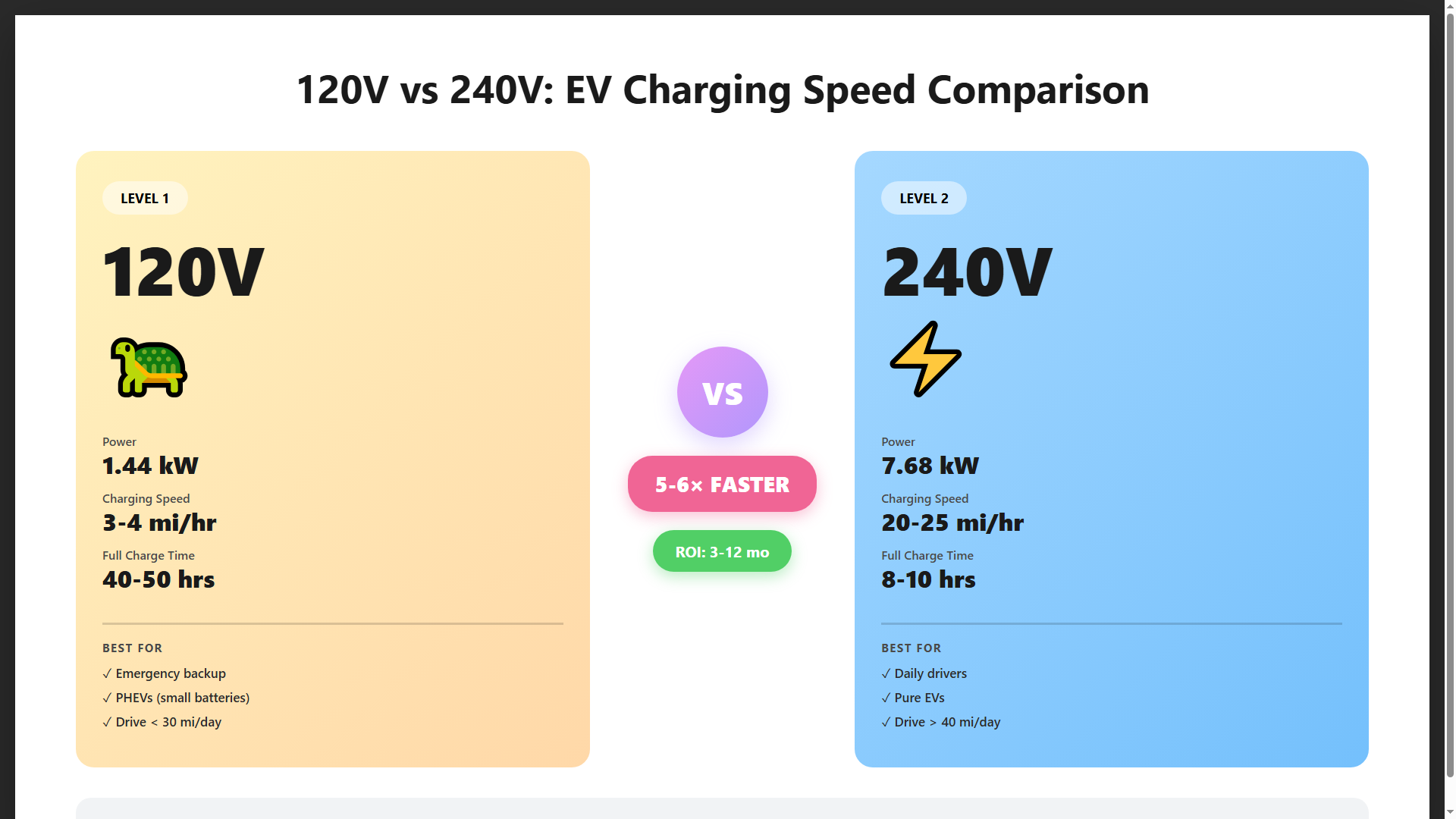
Figure 1: Speed difference between Level 1 (120V) and Level 2 (240V) charging
The Physics Behind 120V Charging Speed
It's All About Power
Charging speed comes down to one simple equation:
Power (kW) = Voltage (V) × Amperage (A) ÷ 1000
With a standard 120V outlet:
-
Voltage: 120V
-
Amperage: 12A (typical for portable EVSE)
-
Power: 120V × 12A = 1,440W = 1.44 kW
Compare that to a 240V Level 2 charger:
-
Voltage: 240V
-
Amperage: 32A (common home installation)
-
Power: 240V × 32A = 7,680W = 7.68 kW
That's a 5.3× difference in charging power—which translates directly to charging speed.
Why 12 Amps? Safety Regulations
The National Electrical Code requires that continuous loads (anything running for more than 3 hours) use no more than 80% of the circuit's rated capacity. So:
-
15A circuit × 80% = 12A maximum
-
20A circuit × 80% = 16A maximum (rare for portable chargers)
This is why most portable 120V EVSEs are limited to 12A, even if your outlet could technically handle more.
Real-World Charging Times: The Numbers
Let's translate power into actual charging speed:
| Metric | 120V Level 1 | 240V Level 2 | DC Fast Charging |
|---|---|---|---|
| Power Output | 1.4 kW | 7-19 kW | 50-350 kW |
| Miles per Hour | 3-4 mi/hr | 20-25 mi/hr | 200-1,000 mi/hr |
| 10-80% Charge | 35-45 hours | 6-9 hours | 20-60 minutes |
| Overnight (8 hrs) | ~30 miles | ~180 miles | N/A |
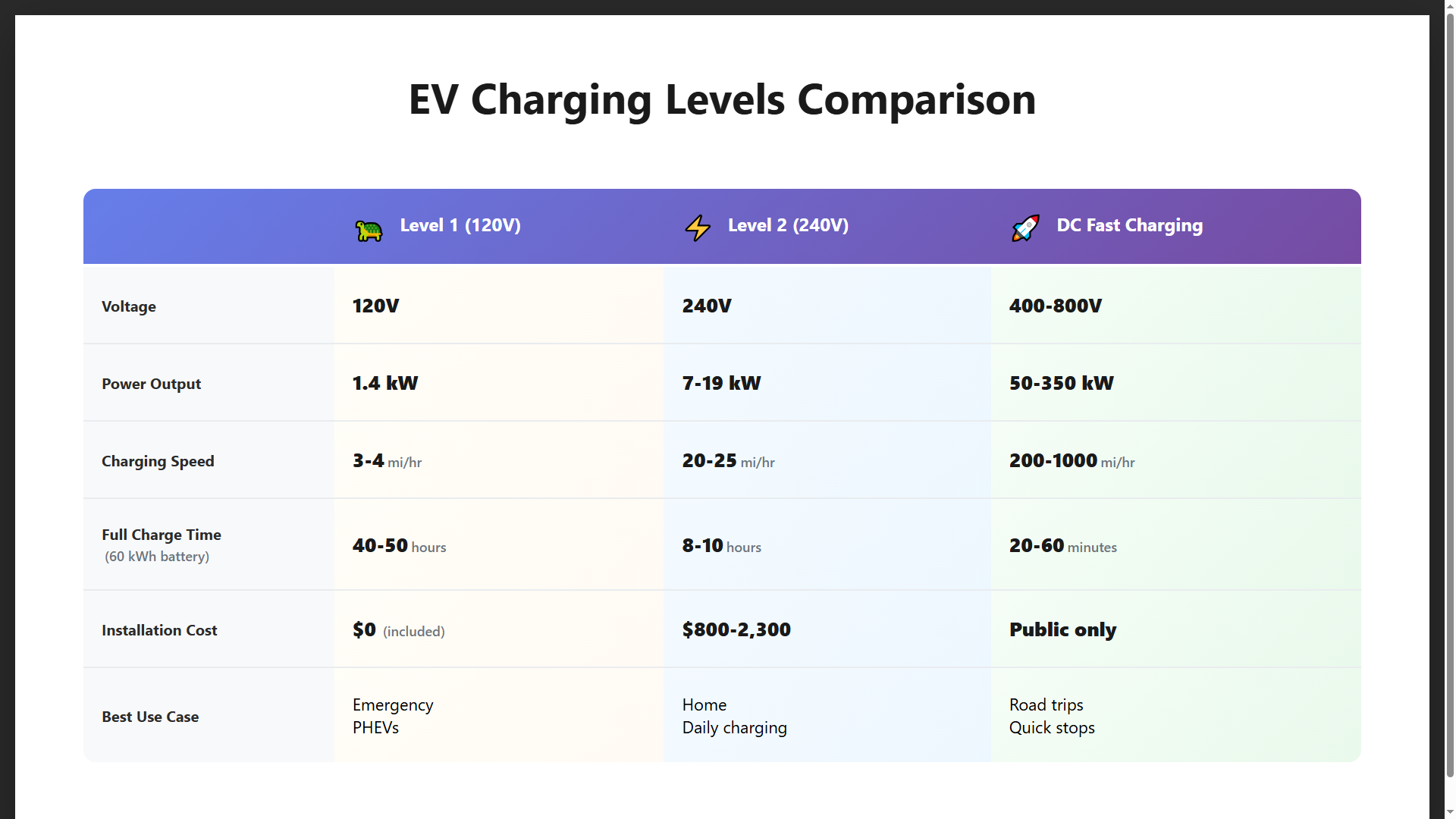
Charging Levels Comparison Table
Example: Charging a Tesla Model 3 Long Range
Battery capacity: 75 kWh Usable capacity (10-80%): ~52.5 kWh
-
120V (1.44 kW): 52.5 ÷ 1.44 = 36.5 hours
-
240V (7.68 kW): 52.5 ÷ 7.68 = 6.8 hours
That's an overnight charge with 240V, versus almost two full days with 120V.
When 120V Charging Actually Works
Despite its limitations, 120V charging isn't useless. It can work well if:
✅ You Drive Less Than 30 Miles Per Day
At 3-4 miles per hour of charging, an 8-hour overnight session gives you:
- 8 hours × 3.5 mi/hr = 28 miles of range
If your daily commute is under 25 miles round-trip, 120V can keep up.
✅ You Have a Plug-In Hybrid (PHEV)
PHEVs have smaller batteries (8-18 kWh). Examples:
-
Toyota RAV4 Prime (18.1 kWh): ~12 hours for full charge
-
Jeep Wrangler 4xe (17.3 kWh): ~11 hours for full charge
-
Chrysler Pacifica Hybrid (16 kWh): ~10 hours for full charge
Since PHEVs have gas backup, slow charging is less critical.
✅ You're Renting or in an Apartment
If you can't install a 240V charger, 120V is your only option. In this case:
-
Charge every night
-
Supplement with public Level 2 charging on weekends
-
Plan longer sessions when parked for extended periods
✅ Emergency Backup
Every EV comes with a 120V portable charger for a reason: emergencies. If you're stranded without a fast charger nearby, 120V can limp you home at 3-4 miles per hour.
When You Should Upgrade to 240V
If any of these apply, 240V becomes essential:
❌ You Drive More Than 40 Miles Per Day
120V can't keep up. You'll constantly be behind on charging, forced to use expensive public DC fast chargers.
❌ You Own a Pure EV (Not a Hybrid)
Pure EVs have larger batteries (50-100 kWh). Charging on 120V takes 2-3 days—completely impractical for daily use.
❌ You Experience "Range Anxiety"
If you frequently worry about running out of charge, 240V eliminates that stress. You wake up to a full battery every morning.
❌ You've Used Public Fast Charging More Than Once a Week
DC fast charging costs $0.40-0.60 per kWh versus $0.10-0.15 at home. If you're relying on public charging, you're losing money fast.
Decision Framework: Should You Upgrade?
Follow this simple flowchart:
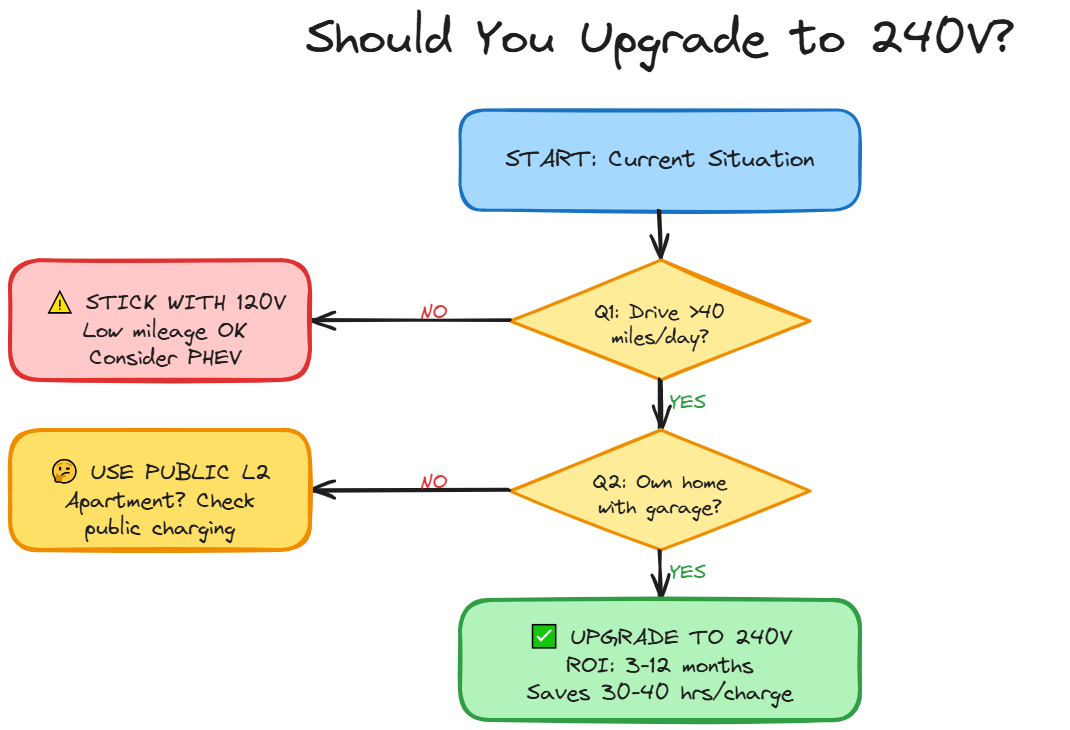
Decision Flowchart
Question 1: Do you drive more than 40 miles per day?
-
YES → Continue to Q2
-
NO → Stick with 120V (for now)
Question 2: Do you own your home with a garage?
-
YES → Upgrade to 240V ✅
-
NO → Consider public Level 2 charging
Question 3: Can you access workplace or public Level 2 charging?
-
YES → Delay home upgrade, use public for 6 months to test
-
NO → Upgrade to 240V ✅
Question 4: Do you plan to keep this EV for 2+ years?
-
YES → Upgrade to 240V ✅ (ROI makes sense)
-
NO → Stick with 120V + public charging
The Financial Case for 240V
Upfront Costs
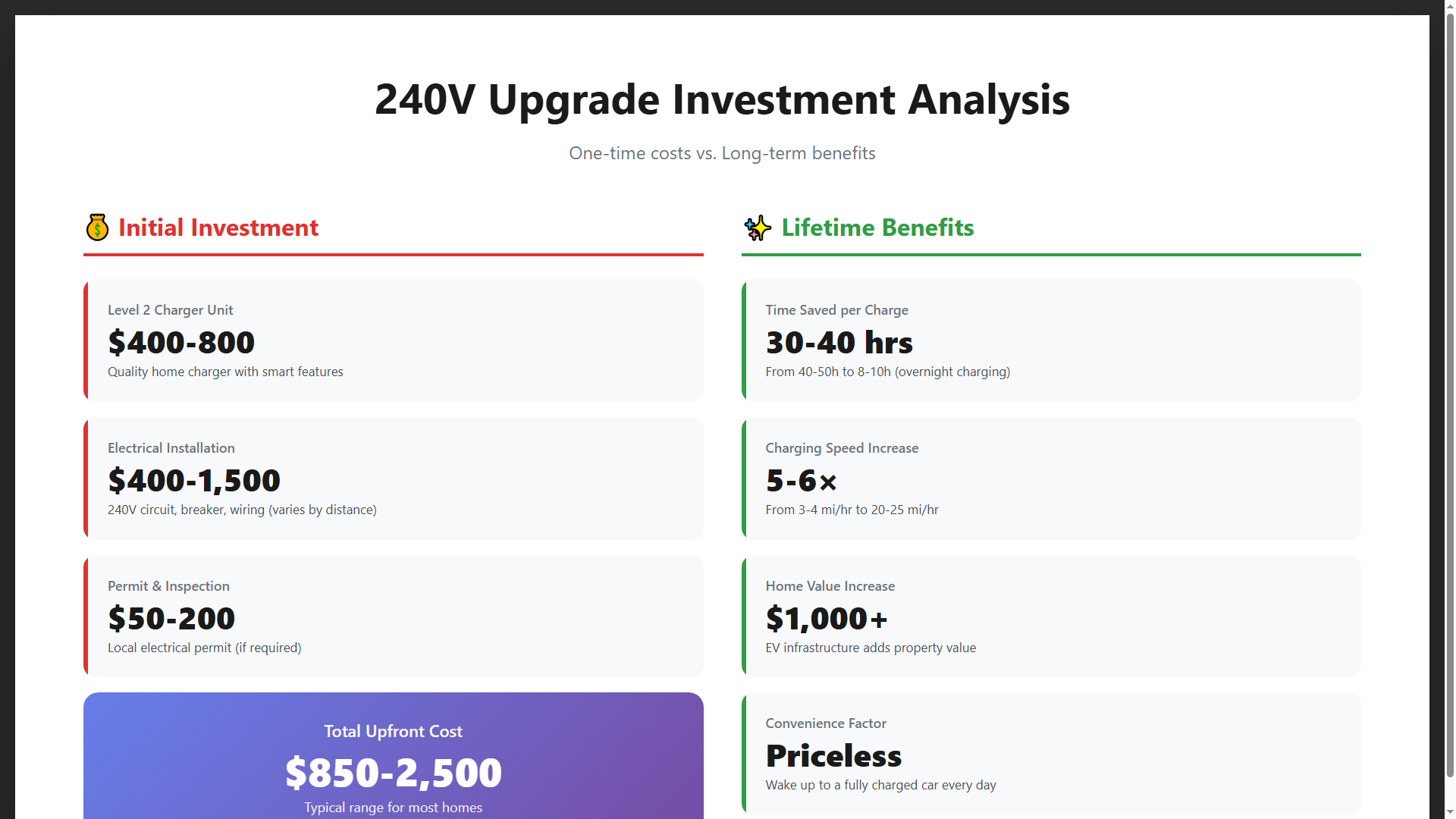
Cost-Benefit Analysis
| Item | Cost Range |
|---|---|
| Level 2 Charger | $400-800 |
| Electrical Work (circuit, breaker, wiring) | $400-1,500 |
| Permit & Inspection | $50-200 |
| Total | $850-2,500 |
Variables that affect cost:
-
Distance from electrical panel to garage
-
Need for panel upgrade (if your home is older)
-
Local labor rates
-
Permit requirements
Long-Term Savings
Time savings: 30-40 hours per full charge Energy cost savings: Avoid $0.40-0.60/kWh public fast charging
Payback calculation (assuming 300 miles per week):
-
Public DC fast charging: 300 mi ÷ 3 mi/kWh = 100 kWh/week
-
Cost at $0.50/kWh: $50/week = $2,600/year
-
Home charging cost at $0.12/kWh: $12/week = $624/year
-
Annual savings: $1,976
With a $1,500 installation, your payback period is 9 months.
Added Home Value
Installing EV charging infrastructure adds $1,000-3,000 to your home's resale value, according to real estate studies. As EV adoption grows, this premium will increase.
How to Upgrade to 240V
Step 1: Assess Your Electrical Panel
Check your home's electrical panel:
-
Look for available breaker slots
-
Note the panel's amperage rating (typically 100A, 150A, or 200A)
Red flag: If your panel is full or below 100A, you may need a panel upgrade ($1,500-3,000 additional cost).
Step 2: Choose Your Charger
Popular options:
-
ChargePoint Home Flex ($699) — WiFi, adjustable amperage, durable
-
JuiceBox 40 ($589) — Smart scheduling, energy tracking
-
Tesla Wall Connector ($475) — Sleek, Tesla-optimized (works with other EVs via adapter)
Key specs to compare:
-
Amperage: 32A (most common), 40A, 48A
-
Cable length: 18-25 feet (measure your parking distance)
-
Smart features: WiFi, app control, scheduling
-
Warranty: 3 years minimum
Step 3: Hire a Licensed Electrician
DIY is not recommended unless you're a licensed electrician. Improper installation voids your charger warranty and creates fire risks.
What to ask electricians:
- Are you licensed and insured?
- Have you installed EV chargers before?
- Can you pull the permit and handle inspection?
- What's included in the quote? (circuit, breaker, conduit, labor)
Get 3 quotes to compare.
Step 4: Apply for Incentives
Check for rebates:
-
Federal: Up to $1,000 tax credit (30% of cost, check current IRS rules)
-
State/Local: Many utilities offer $250-500 rebates
-
Utility time-of-use rates: Charge overnight for 50% lower rates
Example: California's Clean Fuel Reward can stack with federal credits for total savings of $1,500+.
Common Misconceptions About 120V Charging
Myth 1: "120V charging damages the battery"
FALSE. Slow charging is actually gentler on battery health than fast charging. The issue is practicality, not safety.
Myth 2: "I can just use a 120V extension cord"
DANGEROUS. Extension cords overheat under continuous 12A load. Use only:
-
Heavy-duty 12-gauge or thicker cords
-
Cords rated for outdoor use
-
Cords under 25 feet
Better yet: have an electrician install an outlet closer to your parking spot.
Myth 3: "240V charging is only for Teslas"
FALSE. Every EV sold in North America (except Teslas pre-2024) uses the J1772 standard plug. Teslas use NACS but include a J1772 adapter. All Level 2 chargers work with all EVs.
Myth 4: "I can upgrade to 240V myself to save money"
RISKY. Electrical codes require:
-
Proper wire gauge for amperage
-
Correct breaker size
-
GFCI protection
-
Conduit installation
-
Grounding
One mistake can cause fire, electrocution, or insurance claim denial. Hire a pro.
Frequently Asked Questions
Can I charge faster than 12A on 120V?
Some 120V chargers offer 16A (on 20A circuits), giving you ~1.92 kW. That's 5 mi/hr instead of 3-4 mi/hr—still slow, but marginally better. Check your outlet rating first.
Will 240V charging damage my battery?
No. Level 2 (240V) charging is well within safe parameters. DC fast charging (which uses 400-800V) can accelerate degradation if used exclusively, but Level 2 is fine for daily use.
Can I install 240V in an apartment?
Only with landlord permission. Some options:
-
Ask management to install chargers (offer to cover cost)
-
Use nearby public Level 2 chargers
-
Install a portable 240V charger if you have access to a dryer outlet in your garage
How much does 240V charging cost per month?
For 1,000 miles/month at 3 mi/kWh:
-
Energy used: 333 kWh
-
Cost at $0.12/kWh: $40/month
Compare to gas: 1,000 miles ÷ 30 mpg = 33 gallons × $3.50 = $116/month
Is 240V charging loud?
No. Level 2 chargers have no moving parts and are silent. You might hear a faint relay click when plugging in, but nothing during charging.
The Bottom Line
120V charging works if:
-
You drive less than 30 miles per day
-
You own a PHEV
-
You're renting and can't install 240V
Upgrade to 240V if:
-
You drive more than 40 miles per day
-
You own a pure EV
-
You own your home
-
You're tired of range anxiety
Expected ROI: 3-12 months through avoided public charging costs and time savings.
Related Articles
-
J1772 to NACS Adapter: What Works with Tesla (And What Doesn't)
-
EV Charger Overheating on 110V: Understanding Amperage Limits
Need Help Choosing the Right Charger?
At PearlGate, we partner with certified manufacturers to supply high-quality Level 2 charging equipment for homes and commercial installations. Our charging solutions meet UL, CE, and TÜV standards, backed by 11+ years of quality engineering experience.
For distributors and installers: We offer OEM services, private labeling, and volume pricing for charging cables and stations designed for the North American, European, and Australian markets.
Request a Sample | View Our Product Line
Last updated: June 4, 2026 Reading time: 12 minutes
Sourcing EV Charging Equipment from China?
I'm based in the Pearl River Delta with 12 years of supply chain experience. I help buyers find verified EV charging manufacturers, verify certifications, and coordinate factory visits.
Subscribe for more guides like this
Get sourcing tips and new factory alerts. Free, no spam.
No spam. Unsubscribe anytime.