What Is a Portable EV Charger? (And Do You Actually Need One)
If you've spent any time on r/electricvehicles or scrolled through Amazon reviews for EV chargers, you've seen the same questions repeated over and over:
"A portable charger still needs a 240V outlet, and you may find those the limiting factor on most road trips..."
"120V is so slow — only 1-2 miles per hour. Is this even worth it?"
"Bought a portable charger as my main charger. Three months in, here's what I learned..."
The confusion is real. EV manufacturers ship most cars with a basic Level 1 cable, then leave buyers to figure out the rest. Should you upgrade to a Level 2 portable unit? Get a wall-mounted Wallbox instead? Will the cheap one on Amazon actually melt your outlet?
This guide breaks down what a portable EV charger really is, how it works, when it makes sense as your daily driver, and what specs actually matter — whether you're buying one for your garage or sourcing them by the container for resale.
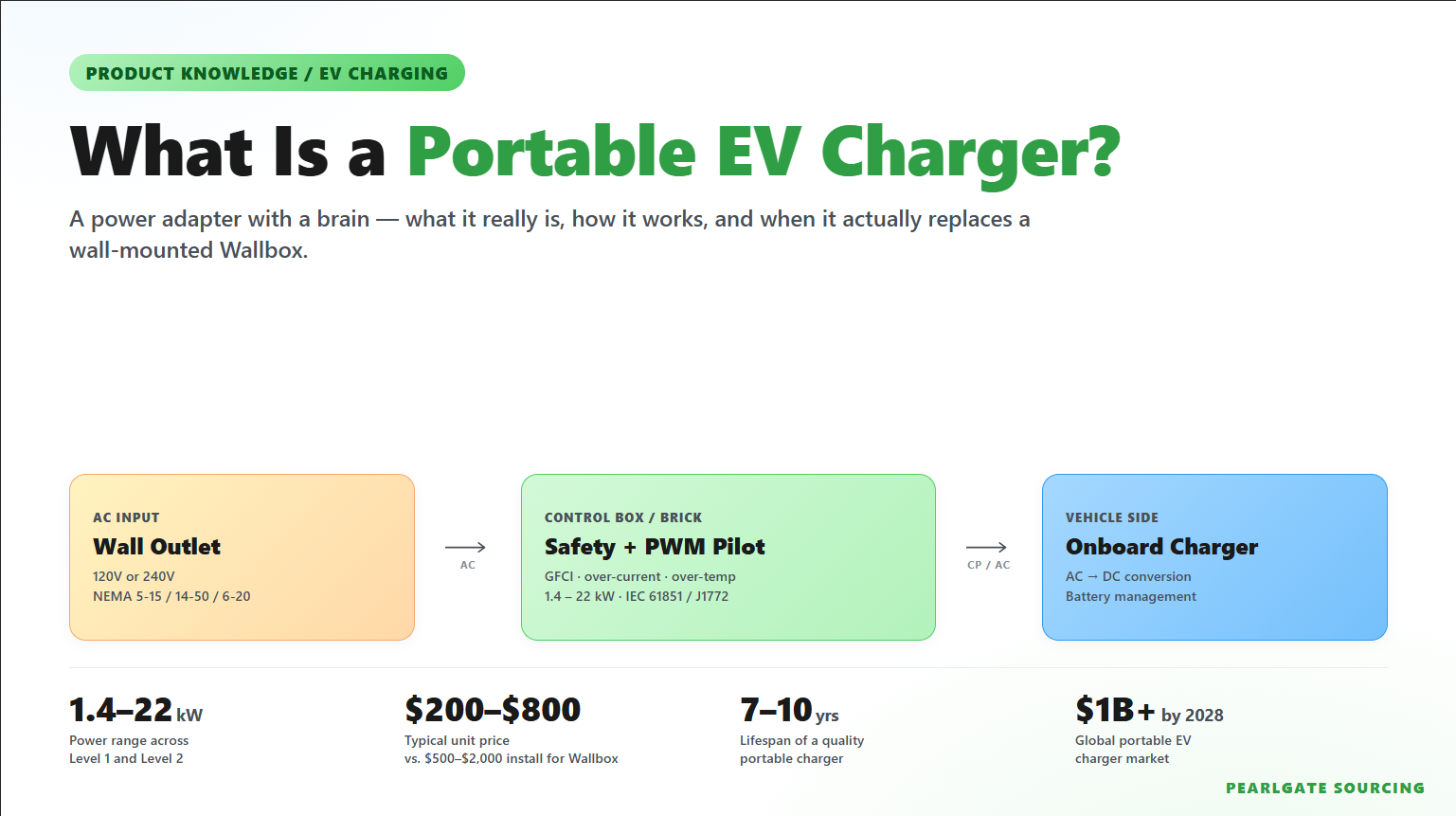
Figure 1: A portable EV charger sits between the wall outlet and your car's onboard charger — handling safety logic, PWM pilot signaling, and power metering.
What Is a Portable EV Charger
A portable EV charger is an off-board charging device — meaning it lives outside the vehicle, not bolted to a wall. It's a self-contained unit with a power cable, a control box (the "brick"), and a connector that plugs into your car. You carry it in your trunk; you plug it into a regular outlet; it charges your car.
Think of it as a power adapter with a brain. The control box handles the safety logic, communicates with your car's battery management system, and meters the current — all while staying small enough to fit in a backpack.
Core characteristics:
- Works with standard household outlets (120V) or higher-voltage outlets (240V NEMA 14-50, 6-20, etc.)
- Power output typically ranges from 1.4 kW (Level 1) to 22 kW (Level 2 three-phase)
- Connector type matches your regional standard: Type 1 / J1772 in North America, Type 2 in Europe, GB/T in China, NACS for newer Tesla and Ford/GM models
- Plug-and-play — no electrician, no permit, no wall-mounting required
How it differs from a Wallbox: A wall-mounted Wallbox is hardwired into your home's electrical panel, usually rated for higher continuous current (40-48A), and built for one location. A portable charger trades some of that raw power and ruggedness for the freedom to use it anywhere there's a compatible outlet — your garage, a friend's house, a hotel parking lot, a campsite.
How a Portable EV Charger Actually Works
There's more happening inside that little brick than people realize. Here's the chain of events when you plug in:
1. AC input → control box. The charger pulls AC power from the wall outlet. Most modern portable chargers handle a wide input range (100V-250V) and auto-detect the voltage.
2. Connector handshake. When you plug into the car, the Control Pilot (CP) signal negotiates with the vehicle. A PWM (pulse-width modulation) signal tells the car the maximum current the charger can deliver. The car responds with a request, and the two agree on a charging rate.
3. Onboard charger takes over. Here's a detail people miss: the AC portable charger doesn't actually convert power for the battery. Your car's onboard charger (built into the vehicle) handles AC-to-DC conversion. The portable unit's job is to deliver clean AC power and handle safety.
4. Continuous safety monitoring. While charging, the control box monitors:
- Over-current — if you draw more than the rated amps, it cuts off
- Over-voltage / under-voltage — protects against grid fluctuations
- Over-temperature — thermistors in the plug and connector watch for hot spots
- Ground fault (GFCI) — detects current leakage to earth
- Connection integrity — if the plug isn't fully seated, charging won't start
5. Termination. When the car says "battery full" or you unplug, the charger ramps current down cleanly before disconnecting — no sparks, no arc.
This is why a quality portable charger costs more than a glorified extension cord: it's a small embedded computer enforcing IEC 61851 / SAE J1772 safety standards every millisecond you're plugged in.
Level 1 vs Level 2: The Speed Reality Check
This is where most buyers get burned. The "portable EV charger" you got with your car is almost certainly a Level 1 unit — and Level 1 is painfully slow for anything beyond emergency top-ups.
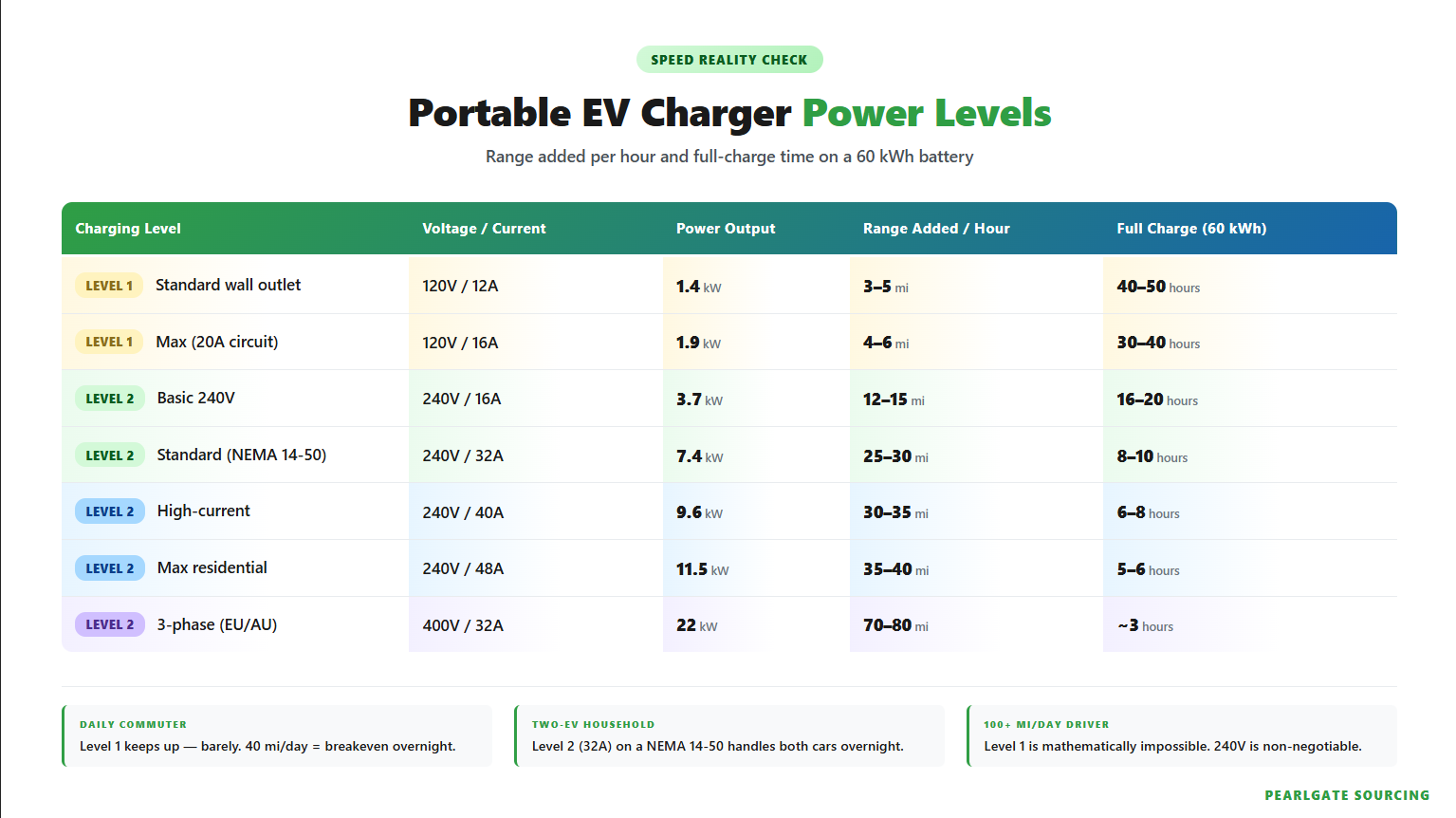
Portable EV charger power levels — range added per hour and full-charge time
| Charging Level | Voltage / Current | Power Output | Range Added per Hour | Full Charge (60 kWh battery) |
|---|---|---|---|---|
| Level 1 | 120V / 12A | ~1.4 kW | 3-5 miles | 40-50 hours |
| Level 1 (max) | 120V / 16A | ~1.9 kW | 4-6 miles | 30-40 hours |
| Level 2 (basic) | 240V / 16A | ~3.7 kW | 12-15 miles | 16-20 hours |
| Level 2 (standard) | 240V / 32A | ~7.4 kW | 25-30 miles | 8-10 hours |
| Level 2 (high) | 240V / 40A | ~9.6 kW | 30-35 miles | 6-8 hours |
| Level 2 (max) | 240V / 48A | ~11.5 kW | 35-40 miles | 5-6 hours |
| Level 2 (3-phase, EU) | 400V / 32A | ~22 kW | 70-80 miles | 3 hours |
Real-world translation:
- Daily commuter (40 mi/day): Level 1 keeps up — barely. Plug in every night, you'll roughly break even.
- Two-EV household: Level 1 falls behind fast. A Level 2 portable on a NEMA 14-50 outlet handles both cars overnight.
- Long-distance driver (100+ mi/day): Level 1 is mathematically impossible. You need 240V, full stop.
- Road trip backup: Level 1 is fine — you're not relying on it as a primary source, just a top-up while you sleep at a motel.
The honest version most reviews don't tell you: a 240V portable charger is the single biggest quality-of-life upgrade for an EV owner. Plug it into a NEMA 14-50 outlet (the same kind used for electric stoves and RV hookups) and you've effectively built a home charging station for $300-500 — no electrician, no wall mount, no permit.
Connector Types: Match the Standard, Not the Marketing
A portable charger is only useful if its plug fits your car. Here's the regional breakdown:
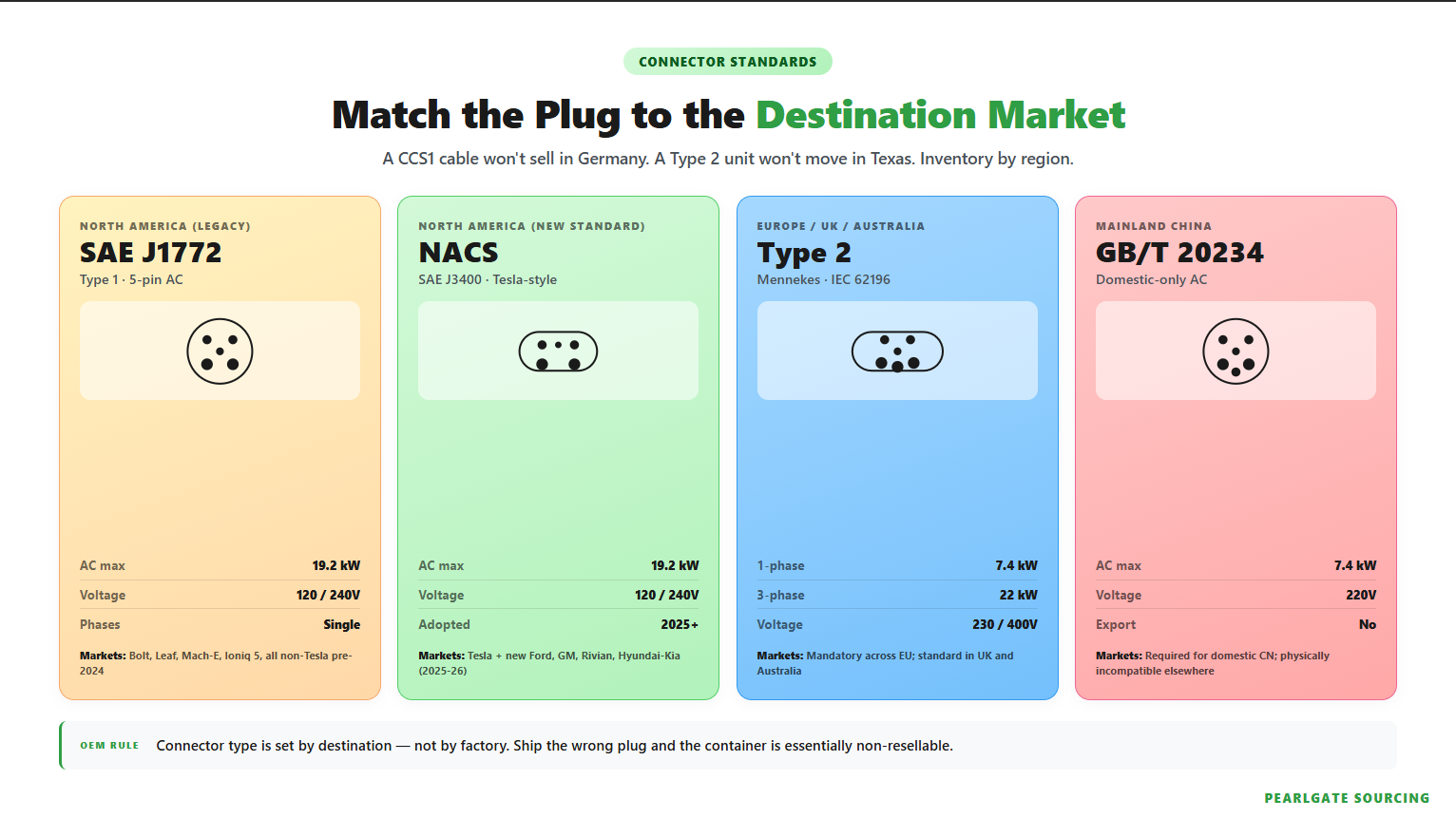
Portable EV charger connector types by region — J1772, NACS, Type 2, GB/T
North America:
- Type 1 / SAE J1772 — Standard for almost every non-Tesla EV sold before 2024 (Bolt, Leaf, Mach-E, Ioniq 5, etc.)
- NACS (SAE J3400) — Tesla's connector, now standard on new Ford, GM, Rivian models from 2025 onward
- Cross-compatibility: J1772 → NACS adapters are cheap and reliable for AC charging. See our J1772 to NACS adapter guide for the trap most buyers fall into.
Europe / UK / Australia:
- Type 2 (Mennekes) — Mandatory across the EU; supports single-phase and three-phase AC
- Single-phase: 7.4 kW max; three-phase: 22 kW max
China:
- GB/T 20234 — Required for the domestic market; physically incompatible with everything else
For OEM and importers: Your portable charger inventory needs to match the destination market exactly. A CCS1 cable assembly won't sell in Germany, a Type 2 unit won't move in Texas, and GB/T inventory is essentially non-resellable outside China.
When You Actually Need One: Real Use Cases
The "do I need a portable charger?" debate on Reddit usually misses that there are five different buyer profiles, each with a different answer.
1. Renter or condo owner with no fixed Wallbox. You can't drill into a leased wall, but your parking spot has a 240V outlet (or you can get one installed). A portable Level 2 charger goes with you when you move — that's $500 you don't lose to the landlord.
2. Two-car household, only one Wallbox. The Wallbox lives on car A. Car B uses a portable Level 2 unit on a second outlet. Cheaper than installing a second hardwired station.
3. Road tripper / backup user. Your daily charging happens at home or DC fast chargers. The portable lives in your trunk for "what if" — campgrounds, motel parking lots, a friend's house. Level 1 is fine for this profile because you're not depending on it.
4. Multi-EV fleet manager. Small fleets (delivery vans, contractor trucks) benefit from portable chargers because trucks don't always come back to the same yard. One unit per truck, plug into whatever 240V outlet is available.
5. Off-grid / solar / emergency-prep buyer. Solar-powered portable chargers are a small but growing category. They're slow (1-2 kW from a typical foldable PV array) but useful for V2L (vehicle-to-load) backup scenarios and remote sites.
If you're none of these — you own your home and you're going to live there for 10+ years — a hardwired Wallbox is the better long-term play. Portable chargers are about flexibility, not raw performance.
Portable Charger vs Wall-Mounted Wallbox: Honest Comparison
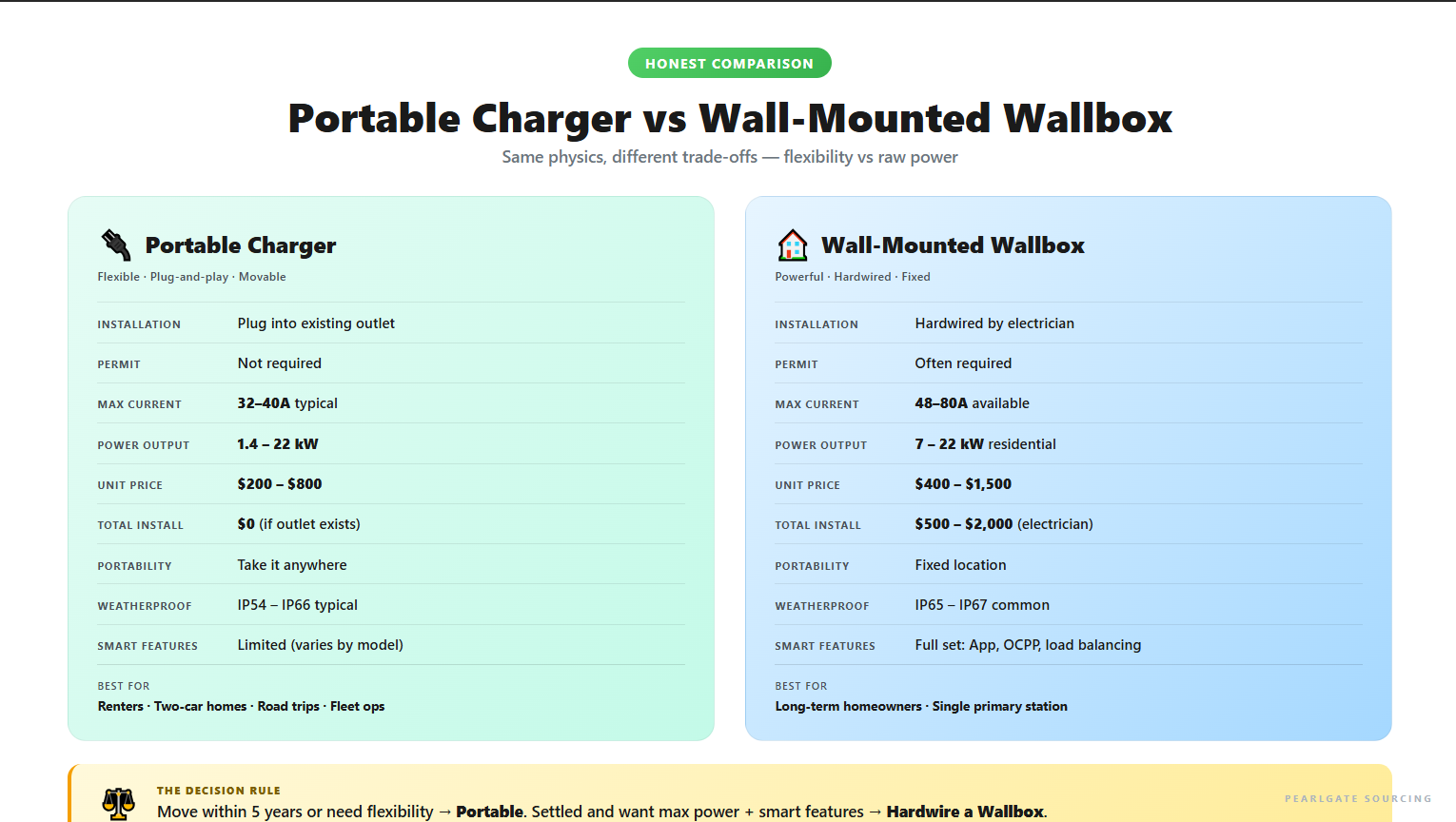
Portable charger vs wall-mounted Wallbox — side-by-side specs and verdict
| Factor | Portable Charger | Wall-Mounted Wallbox |
|---|---|---|
| Installation | Plug into existing outlet | Hardwired by electrician |
| Permit required | No | Often yes (depends on jurisdiction) |
| Max continuous current | 32-40A typical | 48-80A available |
| Power output | 1.4 - 22 kW | 7 - 22 kW (residential) |
| Price (unit) | $200 - $800 | $400 - $1,500 |
| Total install cost | $0 (if outlet exists) | $500 - $2,000 (electrician + outlet/conduit) |
| Portability | Take it anywhere | Fixed location |
| Smart features (App, OCPP, load balancing) | Limited (some models) | Full feature set common |
| Weatherproofing | IP54-IP66 typical | IP65-IP67 common |
| Resale / take-with-you | Yes | No |
| Best for | Renters, two-car homes, trips | Long-term homeowners, single-car primary station |
The simple decision rule: if you'll move within 5 years or need flexibility, go portable. If you're settled and want maximum power and smart features, hardwire a Wallbox.
Key Specs to Look For (Buying Checklist)
Strip away the marketing copy and these are the specs that actually matter:

Portable EV charger buying checklist — six specs that actually matter
Power and current
- Output power: 3.7 kW (16A) for daily commuter, 7.4 kW (32A) for two-car households, 11 kW+ (48A) if your battery is large and you want fast top-ups
- Adjustable current: Premium models let you dial down to 8A/10A/12A/16A/24A/32A — useful when you're plugged into a questionable RV outlet or sharing a circuit
Voltage compatibility
- Dual voltage (120V/240V): Worth the premium if you'll travel between Level 1 and Level 2 outlets. Most quality portables now auto-detect.
- NEMA plug adapters: A 14-50 main plug with adapters for 5-15, 6-20, 14-30 covers 95% of North American outlets
Cable
- Length: 5m (16ft) is the practical minimum; 7.5m (25ft) is the sweet spot; 10m (33ft) for awkward parking situations. Longer cables cost more and weigh more.
- Gauge: Cable thickness should match the rated current. A 32A unit needs proper 10 AWG copper, not aluminum or undersized copper.
Environmental ratings
- IP rating: IP54 minimum for rain resistance; IP65/IP66 for outdoor use; IP67 only matters if you're plugging in during a flood
- Operating temperature: -25°C to +50°C is the standard ask; northern markets (Canada, northern Europe) need -30°C-rated units
Certifications
- North America: UL 2594 or ETL (mandatory), FCC Part 15 (for the radio interference)
- Europe: CE marking with EN 61851-1 / IEC 62752 compliance
- Premium markets: TÜV / GS for Germany, RCM for Australia, KC for Korea
- More on this in the next section — certification is where most cheap units fail
Display and controls
- LCD with charging stats (current, voltage, kWh delivered, time remaining)
- Smart connectivity (WiFi/Bluetooth) is a nice-to-have, not a must-have for portable use
- Avoid units with no display — you have no way to verify they're delivering rated power
Build quality red flags
- Plug pins should be solid brass, not plated steel
- Connector should latch firmly when inserted; no wiggle
- Cable jacket should be flexible at -20°C (test it before buying in winter)
Safety and Certifications: Where Cheap Units Fail
This is the section most "best portable EV charger" listicles skip — and it's the most important for both end users and OEM buyers.
The problem: the EV charger market is flooded with units that claim certification but don't actually have it. A factory can buy a single batch of UL-tested samples, get a "test report," then mass-produce identical-looking units that were never individually certified. End users see "UL Listed" on the box and assume they're safe.
How to verify a real certification:
For UL: every legitimate UL-listed product has a file number (E-prefix). Go to productiq.ul.com and search by file number, manufacturer, or product. If the listing doesn't appear, the certification is fake — period.
For CE: ask for the EU Declaration of Conformity (DoC), the technical file, and verify the Notified Body number if applicable. CE is self-declared in many cases, so the paper trail matters more than the logo.
For TÜV: check the certificate at certipedia.com.
Common safety failure modes in cheap chargers:
- Pin oxidation and overheating — copper plated with nickel instead of silver/gold; develops resistance, generates heat, melts the plug. The 12A-on-a-20A-circuit thermal runaway scenarios reported in Amazon reviews almost always trace to this.
- Underrated cable — labeled 32A but the wire gauge can only handle 24A continuous. Operates fine for short charges, fails on long sessions.
- GFCI without proper testing — protection circuit installed but never validated. Fails to trip on real ground faults.
- PWM signal instability — control pilot duty cycle drifts under load, causing intermittent charging or vehicle compatibility errors (especially on older Bolt/Leaf models).
For the safety-conscious buyer: stick to brands that publish their UL file number on the product page. For sourcing buyers, this is non-negotiable — you can't sell uncertified EV chargers in regulated markets without taking on personal liability.
2026 Market Trends Worth Knowing
The portable EV charger market is in motion right now. A few trends to watch:
Market size and growth. The global portable EV charger segment is projected to exceed $1 billion by 2028, with a CAGR above 15%. Range anxiety and the lag in public charging infrastructure are the two biggest demand drivers — and neither is going away in the next five years.
NACS transition reshapes North America. As Ford, GM, Rivian, and Hyundai-Kia roll out NACS-native vehicles in 2025-2026, the J1772 → NACS adapter market is exploding. But there's a parallel opportunity: portable chargers shipping with NACS connectors natively. Whoever moves first on factory-direct NACS portable chargers (with proper UL certification) wins the next two years.
Solar integration. Portable solar EV chargers — combining a foldable PV array with a portable Level 1/2 charger — are still niche but growing fast. Use cases: off-grid, emergency preparedness, RV / overlanding, V2L applications. Power output is modest (1-2 kW typical) but the addressable market is real.
Bidirectional / V2L. Vehicle-to-Load is starting to ship on production cars (Ford F-150 Lightning, Hyundai Ioniq 5, Kia EV6). Portable chargers that double as V2L adapters will be a meaningful category by 2027.
Tighter certification enforcement. Both the US (CPSC) and EU (market surveillance authorities) have stepped up enforcement against uncertified EV chargers. Expect more import seizures, more recalls, and a flight to quality among serious buyers.
OEM and Sourcing Notes (For B2B Buyers)
If you're buying portable EV chargers in volume — whether you're a regional distributor, an EV accessory brand, or a fleet operator — the buying calculus is different.
MOQ: Most quality factories require 100-500 units for stock SKUs, 500-1,000 for customized configurations.
Lead time: 30-45 days for stock products; 45-60 days for OEM customization; add 60-90 days if certification needs to be redone for new specs.
Customization options worth paying for:
- Logo and packaging — the cheapest differentiation; minimal MOQ impact
- Cable length — match destination market preferences (7.5m for North America retail, 5m for European compact-parking markets)
- Connector colors — fleet customers love color-coding (orange = 16A, red = 32A, etc.)
- Display language — important for non-English markets
Verification points before signing the PO:
- Real certification — UL file number, CE DoC, TÜV certificate, all verified independently
- Sample temperature rise test — run at full rated current for 4 hours, monitor plug and connector temperatures (should not exceed 50°C above ambient)
- PWM signal verification — oscilloscope check on the CP signal under load; should be stable 1 kHz square wave with clean edges
- Cable specs — measure actual conductor cross-section, not just outer diameter
- Compatibility report — request test results against major vehicle models in your destination market
This is where deep manufacturing experience pays off — the difference between a $150 portable charger that lasts 5 years and one that fails in 6 months is mostly invisible until you know what to inspect.
Frequently Asked Questions
Can I use a portable charger as my daily home charger? Yes, if it's a Level 2 unit on a 240V outlet. Plenty of EV owners run 32A portable chargers as their primary home solution — it's effectively a Wallbox without the wall mount. Just pick a quality unit and don't unplug/replug constantly (connector wear is the main long-term failure mode).
Why is 120V charging so painfully slow? Physics. Level 1 maxes out around 1.4-1.9 kW. A typical 60 kWh battery needs 30-40 hours to fill from empty at that rate. The fix is 240V — same charger architecture, four times the power. We covered this in detail in Why 120V EV Charging Is So Slow.
Will it work with my Tesla? If your portable charger has a J1772 connector and your Tesla has the included J1772-to-NACS adapter, yes — for AC charging only. Don't try to use a CCS1-to-NACS adapter on a J1772 portable; that's a DC fast charging adapter and won't work. Full breakdown in our J1772 to NACS adapter guide.
Is it safe to use in the rain? Quality units rated IP54 or higher are safe in rain when properly connected. The connection point at the car is the only sensitive area, and modern EV inlets are designed to handle wet weather. Don't submerge the control box.
Can a portable charger overheat my home outlet? It can, if the outlet or wiring is undersized. The classic failure: a 32A charger plugged into a 30A circuit, or any high-current charger on aluminum-wired homes (1960s-70s construction). Have an electrician verify your circuit before using anything above 16A.
What's the typical lifespan? A quality portable EV charger should last 7-10 years of daily use. Wear points: the connector latch (mechanical fatigue), the cable strain relief (where it enters the control box), and the relay contacts inside the brick. Cheap units fail in 1-3 years.
Can I bring it overseas? Only if the destination uses a compatible standard. North American J1772 units don't work in Europe (Type 2 required), Chinese GB/T units don't work outside China. Voltage matters too: a 240V-only unit won't work in regions with 220V supply unless explicitly rated for both.
Bottom Line
A portable EV charger is the most flexible, lowest-friction way to get reliable home charging — if you have the right outlet and you buy a properly certified unit. For renters, two-car households, road-trippers, and fleet operators, it's often the better choice over a hardwired Wallbox.
The rules are simple:
- Match the connector to your car (J1772 / Type 2 / NACS / GB/T)
- Go Level 2 (240V) unless you're using it strictly as a backup
- Verify certifications independently — don't trust the box
- Pay for build quality — the $200 difference between a quality unit and a cheap one is the cheapest insurance you'll buy
For OEM buyers and importers: this category is one of the highest-margin, fastest-growing segments in EV accessories — but only if you partner with factories that take certification and quality seriously. PearlGate's role is to verify factories on the ground, witness QC testing, and validate certifications before your container ships. Contact us if you're sourcing portable EV chargers for North American, European, or Australian markets.
Related reading:
Sourcing EV Charging Equipment from China?
I'm based in the Pearl River Delta with 12 years of supply chain experience. I help buyers find verified EV charging manufacturers, verify certifications, and coordinate factory visits.
Subscribe for more guides like this
Get sourcing tips and new factory alerts. Free, no spam.
No spam. Unsubscribe anytime.